



Avoid Baggage Fees in 2026: Carry-On or Use a Card If You Fly Twice
The fastest ways to avoid baggage fees in 2026 are packing carry-on only, using a co-branded airline credit card that waives your first checked bag, prepaying online instead of at the airport, chasing status or a bundled fare that already includes bags, and shipping heavy luggage ahead when checking one is unavoidable. Start with carry-on only if your trip allows it. If not, a card or a bundled fare usually beats paying gate rates.
TL;DR:
- Packing carry-on only remains the most reliable method to avoid baggage fees for trips under two weeks, provided the airline allows it.
- Using a co-branded airline credit card can waive the first checked bag fee for travelers who fly the same carrier multiple times annually.
- Prepay your checked bag online during booking, as it is consistently cheaper than paying at the airport gate.
- Shipping bulky or heavy luggage ahead of time can be more cost-effective than paying for oversized or overweight baggage fees.
- Confirm baggage policies and benefits before booking, especially if paying with third-party sites or booking fare classes that exclude fee waivers.
Table of Contents
- How to Avoid Baggage Fees: A Quick-Start Checklist
- How Do You Pack Carry-On Only for a Week-Long Trip?
- Should You Get an Airline Credit Card to Skip Bag Fees?
- When Does Paying for Status or a Premium Fare Beat Bag Fees?
- What Pre-Departure Steps Cut Baggage Costs the Most?
- How Do You Avoid Overweight and Oversize Baggage Fees?
- When Should You Ship Luggage Instead of Checking It?
- Small Habits That Actually Cut Bag Costs
- A Practical Upgrade for Carry-On-Only Travel
- Where to Verify Baggage Fees and Card Benefits
- Sources
- FAQ
How to Avoid Baggage Fees: A Quick-Start Checklist
Not every tactic fits every trip, so work down this list in order of how easy each one is to pull off.
- Pack carry-on only. The single most reliable way to dodge fees entirely, best for trips under two weeks.
- Use a co-branded airline credit card. Best for anyone who flies the same carrier two or more times a year.
- Prepay your bag online. Always cheaper than paying at the counter, so do this the moment you book if you know you’re checking a bag.
- Chase status or book a bundled fare. Worth it for families or travelers who check bags on every trip.
- Ship your luggage ahead. Makes sense for oversized gear, long trips, or one-way moves where checking fees stack up fast.
- Volunteer to gate-check. A last-resort, day-of-flight move when overhead bins fill up.
How Do You Pack Carry-On Only for a Week-Long Trip?
Most U.S. carriers allow one personal item (roughly 18 x 14 x 8 inches) and one carry-on (roughly 22 x 14 x 9 inches), though Basic Economy fares on some airlines strip out the carry-on entirely and limit you to the personal item alone. Check your fare class before you pack, not after you’re at the gate.
Once you know your allowance, the packing method matters more than the bag itself. A few tactics that consistently work:
- Build outfits around two or three color palettes so every top pairs with every bottom.
- Use packing cubes to separate categories (tops, bottoms, underlayers) and compress air out of soft goods.
- Roll rather than fold for anything that wrinkles poorly, and wear your bulkiest shoes and jacket on travel days instead of packing them.
- Reserve one packing cube or compression bag exclusively for dirty laundry on the return leg.
Compression tools can stretch a standard 40-liter carry-on far enough to handle a full week, sometimes longer, without checking anything, according to The Points Guy’s rundown of 2026 baggage rules. Vacuum-style compression bags are TSA-friendly since they carry no liquids or batteries that require separate screening, but they don’t expand your bag’s outer dimensions. Overstuff one and you’ll still get flagged at a sizing bin.
Pro Tip: Do a full dry run at home before travel day. Pack the bag, zip it, and pick it up. If it feels heavier than you’d want to carry through three terminals, take something out now instead of discovering it at the gate.
Should You Get an Airline Credit Card to Skip Bag Fees?
For frequent flyers on one carrier, yes. Most co-branded airline cards waive the fee for your first checked bag, and some extend that waiver to companions traveling on the same reservation, according to Travel On Points’ comparison of card benefits.
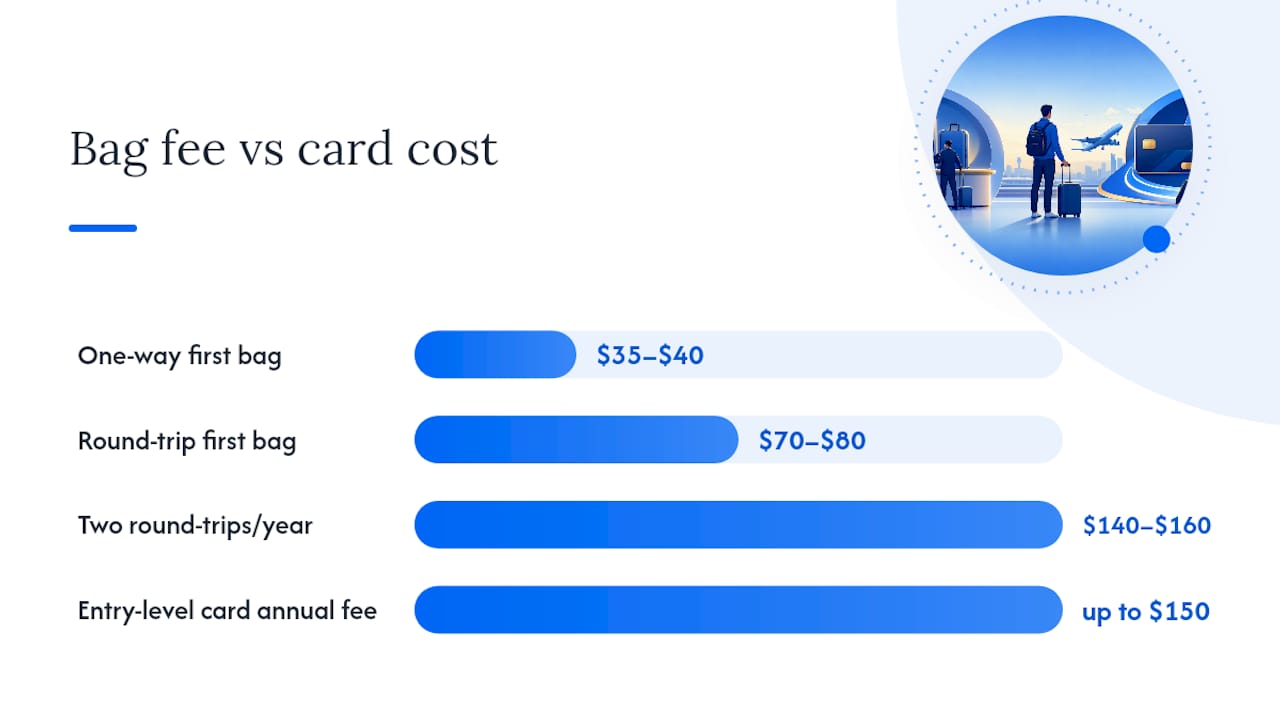
The math is simple. Annual fees on entry-level co-branded cards typically run up to $150. If a round-trip first bag runs around $35 to $40 each way, two trips a year can already cover the card’s cost. Families traveling together multiply that benefit, since one cardholder’s waiver can sometimes cover the whole party.
A few gotchas trip people up:
- You usually must pay for the ticket with that specific card to unlock the waiver.
- Basic Economy fares are frequently excluded, even if you hold the card.
- Booking through a third-party site instead of directly with the airline can void the benefit.
Verify the exact terms on the issuer’s benefits page before you book, since rules shift and vary by card tier.
When Does Paying for Status or a Premium Fare Beat Bag Fees?
Elite status and many premium cabins include free checked bags as a standard perk, which changes the math for anyone who checks a bag on nearly every trip. Airline status tiers typically require a set number of qualifying flights or dollars spent per year, so this route rewards loyalty more than one-off bookings.
The smarter comparison for most travelers is total trip cost, not base fare. Add ticket price plus bag fees plus any waived benefits, then compare that number against a bundled fare that already folds bags into the price, a method Trips With Tykes recommends for family bookings specifically.
- A bundled fare often wins once you’re checking two or more bags per traveler.
- Long-haul international routes frequently include a free checked bag even on standard economy fares.
- Families should multiply (ticket price × travelers) plus (bag fees × travelers × direction) to see the real total before choosing.
What Pre-Departure Steps Cut Baggage Costs the Most?
Run this short routine before you leave for the airport:
- Prepay your bag online. Airport and gate pricing almost always cost more than the online rate, per Organizing.
- Weigh your bag at home using a hand luggage scale and pack toward roughly 45 pounds if the airline’s limit is 50, leaving a buffer for scale variance.
- Reread your fare class rules, since carry-on allowances and bag pricing now shift by fare tier and even by route on some carriers, a trend the Department of Transportation requires airlines to disclose clearly at booking.
How Do You Avoid Overweight and Oversize Baggage Fees?
Overweight penalties can run well past $100 once you cross the standard 50-pound threshold, and oversize fees stack on top if your bag exceeds linear dimension limits, according to Navan’s baggage guidance. The fix starts before you leave home.
- Weigh your bag with a luggage scale and stay a few pounds under the limit, not right at it.
- If you’re over, shift weight into a carry-on or a companion’s bag rather than paying at check-in.
- Wear your heaviest jacket, boots, or coat instead of packing them.
- If bins look full at boarding, volunteering to gate-check is often free and gets your bag on the same flight, according to traveler reports from United flyer communities.
When Should You Ship Luggage Instead of Checking It?
Shipping makes sense once your bag’s fees start rivaling a courier quote, which happens often with oversized sports gear, musical instruments, or a one-way move. Dollar Flight Club notes that specialized luggage shippers frequently beat airline oversize and extra-bag pricing when you plan ahead.
- Compare door-to-door shipping quotes, including insurance, against the airline’s combined checked, overweight, and oversize charges.
- Book shipping with enough lead time. Most services need several business days, not overnight turnaround.
- For regional or shorter trips, driving or taking a train can beat flying entirely once you factor in baggage costs and airport time.
- If you ship ahead, confirm delivery tracking and coordinate arrival timing with your hotel or rental so the bag isn’t waiting outside.
For bulky specialty gear like fishing or outdoor equipment, a dedicated packing guide for anglers walks through when shipping rods and gear beats airline oversize fees outright.
Small Habits That Actually Cut Bag Costs
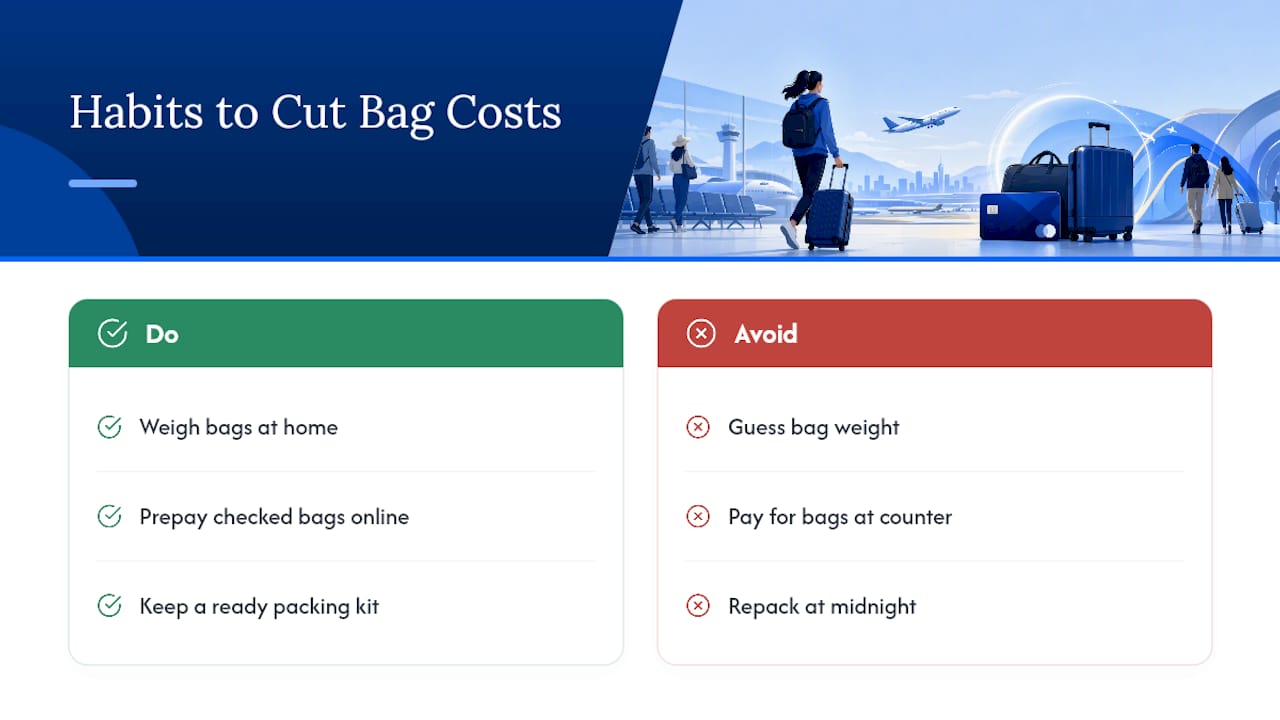
The travelers who consistently dodge bag fees aren’t the ones with the fanciest hacks. They’re the ones who weigh their bag before leaving the house, prepay the moment a checked bag looks likely, and keep a packing kit ready so last-minute trips don’t turn into overpacked scrambles. That’s a pattern worth watching closely when you cover travel logistics for a living, and it holds up trip after trip: the fee usually gets avoided in the planning, not at the counter.
Three habits worth building into every trip: weigh at home with a real scale, not a guess. Prepay online the second checking a bag looks likely. And keep a compact packing kit assembled year round so you’re never repacking from scratch at midnight.
— Hugh
A Practical Upgrade for Carry-On-Only Travel
If carry-on-only is your main strategy, the limiting factor usually isn’t the bag’s outer dimensions. It’s how much you can actually fit inside them before running out of usable space. That’s the specific problem Stoiqstorage’s compression bags solve.

The built-in rechargeable pump lets you compress clothes and soft goods without hunting for a separate vacuum device or an outlet, and the design aims for TSA compliance so you’re not gambling at the checkpoint. Travelers who pack heavier for longer trips or family vacations often reach for the Stoiq Compression Backpack, which pairs the compression system with a dedicated travel backpack rather than a standalone bag. Over 20,000 travelers have used Stoiq’s compression system to fit more into a single carry-on, according to Stoiq’s customer reviews. If you’re planning your next trip around avoiding a checked bag entirely, browse the Carry-On Solution collection and see which size fits your travel pattern.
Where to Verify Baggage Fees and Card Benefits
Fee details and card terms change often enough that it’s worth checking primary sources directly rather than relying on memory from your last trip.
- The Points Guy’s 2026 baggage fee tracker for current per-carrier pricing.
- DeepArrival’s coverage of the spring 2026 fee increases for how the latest hikes apply to existing bookings.
- Travel On Points’ card comparison for which co-branded cards waive bag fees and under what conditions.
- Navan’s guide to overweight baggage penalties for typical overage costs and thresholds.
Sources
- Airline baggage fees 2026 — The Points Guy
- Credit cards with free checked baggage — Travel On Points
- Those bags are going to cost you — Trips With Tykes
- What is overweight baggage — Navan resources
FAQ
How Do I Get My Baggage Fee Waived?
The most common ways are paying with a co-branded airline credit card that includes a free first checked bag, holding elite status, or booking a fare class that bundles bags into the price. Always confirm the waiver applies to your specific fare and payment method before you book.
Who Has the Cheapest Checked Bag Fee?
Pricing shifts by carrier and route, and several major U.S. airlines raised checked-bag rates in spring 2026, so the cheapest option changes often, according to DeepArrival’s coverage of the increases. Compare total trip cost, fare plus bag fees, rather than the bag fee alone before booking.
Do Any Airlines Still Offer Free Checked Bags?
Some carriers still include a free checked bag on premium cabins, certain international long-haul fares, or for elite status holders. Outside those cases, most domestic economy fares now charge for every checked bag, which is why a co-branded card or bundled fare has become the more reliable free-bag route.
Which Airlines Are Raising Their Baggage Fees?
Major U.S. carriers raised checked-bag pricing across the board in April 2026, affecting both first and second bag fees, according to DeepArrival’s reporting. Fees charged depend on the rate in effect on your ticketing date, so bookings made before an increase are typically protected.
What’s the Easiest Way to Avoid Checked Bag Fees Without a Credit Card?
Packing carry-on only remains the simplest fee-free option, and tools like compression bags can help you fit more into the standard carry-on size limit. For trips where checking a bag is unavoidable, prepaying online instead of at the airport still cuts the cost noticeably.
