



Compress Clothes 2–3×: Backpack vs Duffel for Travelers & Gym Goers
For hands-free transit and organized tech, choose a backpack. For raw volume and bulky gear you’re carrying short distances, choose a duffel. The exception: frequent flyers who compress soft items can often make either format work, since less bulk means both bag types perform better than their base specs suggest.
TL;DR:
- A backpack’s weight distribution offers better comfort during long walks and airport transfers, especially with padded harnesses and supportive belts.
- Duffels excel at packing bulky, oddly shaped items due to their open cavity, making them ideal for soft gear like towels and shoes.
- Backpacks provide structured organization with dedicated compartments and quick-access features, whereas duffels prioritize speed with single large openings.
- In crowded transit, backpacks keep valuables safer against your back, but duffels may be easier to slide into overhead bins or under seats.
- Compression systems, such as vacuum bags, significantly increase usable capacity for both, making a carefully packed duffel or backpack more efficient.
Table of Contents
- Backpack vs Duffel Bag: The Quick Comparison
- How Do Comfort, Capacity, and Access Actually Compare?
- Which Bag Fits Your Trip, Gym Bag, or Commute?
- Do Compression Systems Change the Backpack vs Duffel Decision?
- What I’ve Learned Choosing Between These Bags
- Get More Out of Either Bag With Stoiq
- Sources
- FAQ
Backpack vs Duffel Bag: The Quick Comparison
Before you commit to one bag format, it helps to see how each performs across the factors that actually change your travel day. Here’s the breakdown by category.
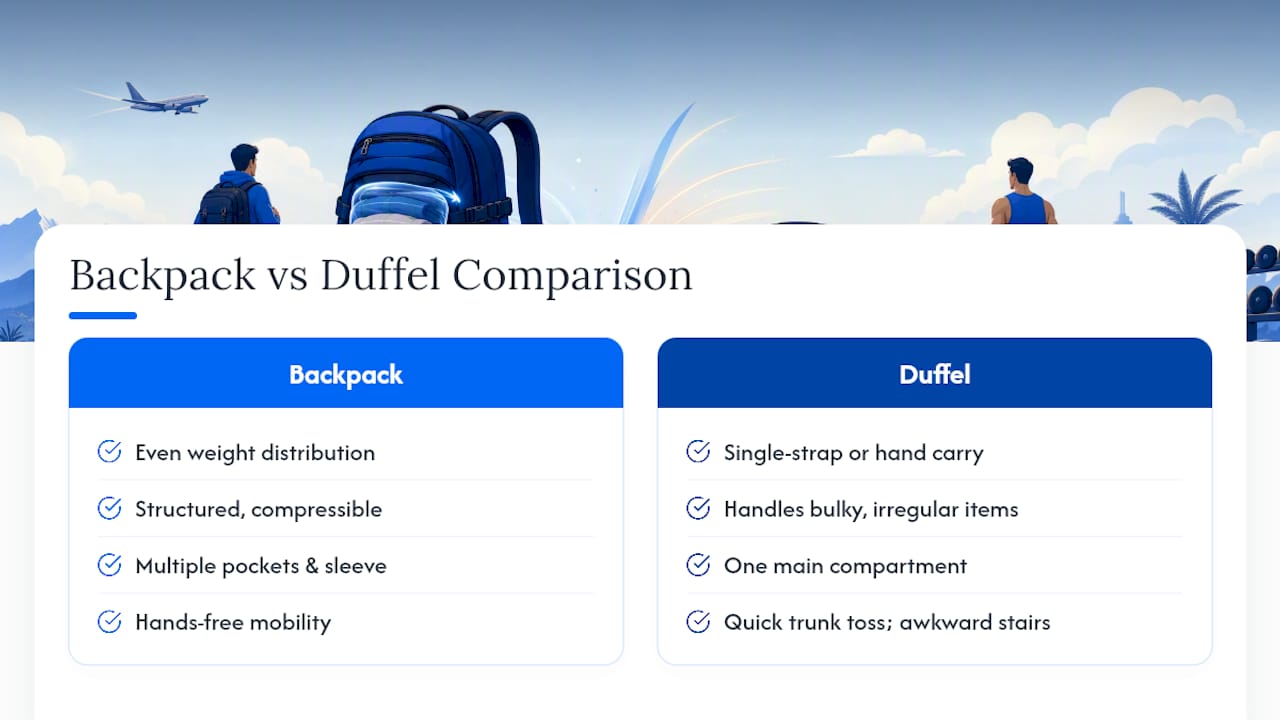
Comfort: Backpacks distribute weight across both shoulders with padded harnesses, sternum straps, and hip belts, which matters most on multi-terminal connections or cobblestone streets. Duffels rely on a single shoulder strap or hand grip, fine for short carries but rough on the trapezius after 20 minutes.
Capacity and shape: Duffels handle bulky, irregularly shaped items like sleeping bags, cleats, and wet towels well because the open cavity accommodates such shapes better than backpacks. Backpacks favor vertical stacking and compression, rewarding organized packers over volume-first packers.
Organization: Backpacks typically win with dedicated laptop sleeves, clamshell openings, and multiple pockets. Duffels usually offer one main compartment plus a couple of end pockets, trading structure for speed.
Portability: Backpacks keep your hands free through security lines, train platforms, and rideshare pickups. Duffels carry faster for a quick trunk toss but become awkward on stairs or in crowded aisles.
Security: Backpacks let you keep valuables against your back, out of easy reach. Duffels expose side pockets to pickpockets in dense crowds.
Quick picks: gym-goers who tote sneakers and towels lean duffel; commuters guarding a laptop lean backpack; weekend travelers who value mobility lean backpack; business travelers protecting garments often lean duffel.
How Do Comfort, Capacity, and Access Actually Compare?
The specs on a product page rarely tell you how a bag feels three hours into a layover. Here’s what actually separates these two formats once you’re moving through a real airport, gym, or train platform.
Comfort and ergonomics
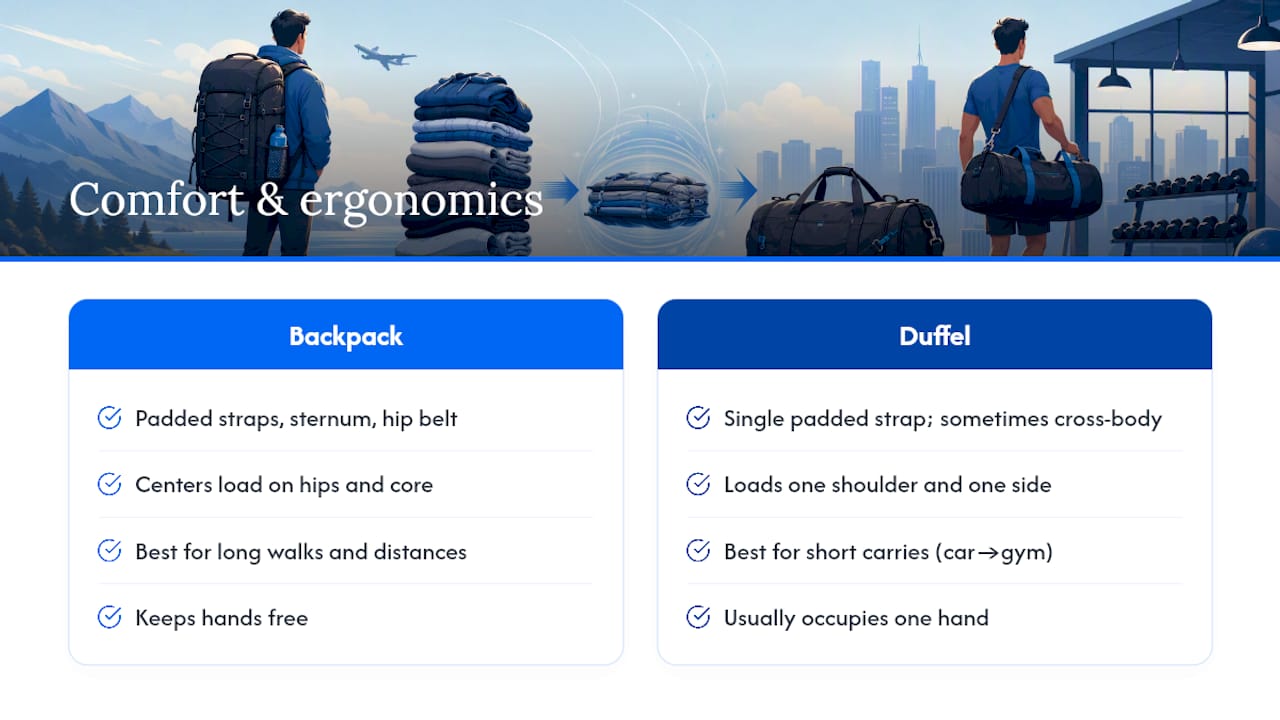
A backpack’s harness system is the biggest reason it wins over long distances. Padded shoulder straps paired with a sternum strap and hip belt shift weight off the shoulders and onto the hips and core, which is exactly how hiking packs have worked for decades. That structural support is why a 20-pound backpack feels lighter than a 15-pound duffel slung over one shoulder for the same walk.
Duffels skip all of that. Most rely on a single padded strap, sometimes with a cross-body option, but the weight still concentrates on one shoulder and one side of your neck. For a five-minute walk from the car to a gym locker, that’s irrelevant. For a 25-minute walk through an airport with a connection to catch, it starts to hurt, and backpacks keep your hands free and your load centered in a way a duffel simply cannot match. The tradeoff runs the other way too: backpacks put sustained pressure on your shoulders and back over an entire day, so if you’re mostly sitting in a car or rideshare between short carries, a duffel’s occasional strain beats a backpack’s constant load.
Capacity and packing geometry
This is where duffels genuinely shine. Their single open cavity doesn’t care about item shape, so bulky soft items like shoes, towels, or uniforms pack in far more efficiently than they would into a backpack’s structured, subdivided interior. Toss in a pair of cleats, a rolled yoga mat, and a wet swimsuit, and a duffel absorbs the irregular shapes without wasted space.
Backpacks flip that logic. Their vertical stacking design rewards rectangular, compressible items, think folded clothing, packing cubes, or a laptop sleeve, but that same structure fights back against oddly shaped gear. A basketball or a rolled tent will eat far more usable volume in a backpack than it will in a duffel’s soft-sided cavity. If your packing list is mostly clothes and electronics, a backpack’s compression straps and internal frame let you squeeze in more. If your packing list is mostly gear, a duffel wins on raw usable space.
Organization and access
Backpacks generally offer more structured organization: dedicated laptop compartments, mesh pockets for cables, and a front organizer panel for passports and pens. Many premium travel backpacks now use a clamshell opening that lies flat during security screening, letting you slide a laptop out without fully unpacking, which shaves real time off the TSA line.
Duffels trade that structure for speed. A single top-zip opening means you can shove things in and pull them out fast, ideal for a gym bag you’re packing half-asleep at 6 a.m. But that same simplicity becomes a liability when you’re digging for a passport at the bottom of a duffel stuffed with clothes. If you travel with a laptop regularly, the backpack’s dedicated sleeve and faster screening process matter more than they might seem to on paper.
Portability and transit fit
Hands-free carry is the backpack’s clearest advantage on mixed-transit trips, subways, cobblestone streets, stairwells without elevators. You can run for a train, hold a coffee, and check your phone all at once. Duffels demand a hand or a shoulder at all times, which becomes exhausting on a trip with multiple transfers.
Where duffels pull ahead is width. A backpack’s depth can make it awkward in narrow airplane aisles or between subway seats, while a duffel lies flatter and slides more easily into overhead bins or under seats when packed correctly. Before you fly, check your actual bag dimensions against your airline’s limits. Manufacturers frequently list generous “carry-on compatible” claims that don’t account for real under-seat clearance, and testing your packed bag before departure avoids a gate-check surprise.
Durability and materials
Look for fabric weight (measured in denier), reinforced base panels, and YKK-style zippers on both formats, but pay extra attention to strap and handle stitching, since that’s where duffels usually fail first under repeated gym or airport use. Backpacks tend to distribute stress across a wider harness system, so their failure points are more often zippers than seams.
Security
Backpacks let you carry valuables against your back, which is harder for a pickpocket to access in a crowded metro car or market. Duffels leave side pockets exposed at hip height, an easy target in dense crowds. If you’re navigating a busy transit hub with cash, a passport, or electronics, the backpack’s positioning does real work here.
Which Bag Fits Your Trip, Gym Bag, or Commute?
The right bag depends less on brand preference and more on your actual trip pattern. Here’s how it breaks down by scenario.
-
Gym: Choose a duffel when you’re mainly hauling shoes, a towel, and a change of clothes, since the open cavity swallows bulky, wet gear without a fight. Choose a backpack if you’re also carrying a laptop or wallet you plan to keep on your body between the gym and the office. One practical note: duffels tend to keep electronics safer when the bag itself sits in a locker, since wet items stay contained in one compartment instead of soaking a backpack’s shared interior.
-
Daily commute: Backpacks win for laptop security, pocket organization, and hands-free transit through crowded stations. A duffel only makes sense here if you drive to work and the walk from car to desk is under a few minutes.
-
Weekend trip: Favor a travel backpack when you’ll be walking, using rideshares, or navigating unfamiliar transit. Favor a duffel if the trip is car-first and you’d rather prioritize packing volume over mobility.
-
International carry-on: A clamshell backpack with a laptop sleeve moves faster through security and keeps electronics accessible without a full repack. Always measure your packed bag against your specific carrier’s dimensions before departure, since limits vary by airline and fare class.
-
Road trip or car travel: Duffels are usually the better call. They stack more easily in a trunk and their soft sides flex around other cargo in ways a rigid-backed backpack cannot.
-
Business travel: A structured duffel or garment-forward bag often protects dress clothes and projects a more polished image than a backpack, particularly for short overnight trips where aesthetics and presentation genuinely factor into the choice.
Do Compression Systems Change the Backpack vs Duffel Decision?
Compression changes the math for both formats, and it’s worth understanding before you buy either bag. A duffel’s soft sides do open up more room. Vacuum compression bags with an integrated pump can go a step further, Stoiq’s design claims 2 to 3 times more usable carry-on capacity by pulling air out of soft items like sweaters and jackets, which lets a duffel or backpack hold more without adding weight in a way that trips a scale.
Smart packers also avoid the trap of forcing one bag to do every job. A better approach:
- Pair a main bag (duffel or backpack) with a small personal-item backpack for your phone, wallet, and passport, since that combination balances access and volume better than a single overloaded bag.
- Use packing cubes for structure inside a backpack; use compression bags for bulky soft items like sweatshirts, jackets, and towels regardless of which bag format you’re using.
- Compressed items also lie flatter, which matters for under-seat clearance and overhead bin fit, and flat items move through screening faster since they don’t jam against the X-ray belt.
- Reserve your backpack’s front pockets and quick-access compartments for essentials you need mid-transit: boarding pass, headphones, a snack.
Pro Tip: Compress your bulkiest, least-fragile items first, sweatshirts and towels before shoes, so you free up structural space for the things that actually need it.
What I’ve Learned Choosing Between These Bags
My default used to be backpack, always, until a work trip where I packed a duffel for a car-based conference and immediately felt the difference: less time wrestling zippers, more room for a garment bag folded flat on top. That trip flipped a rule for me. If I’m walking more than 15 minutes regularly, backpack wins, full stop. If I’m car-first with short carries, duffel wins just as clearly. The honest answer is that neither bag is “better,” they’re built for different physical realities, and the mistake most people make is picking a format based on looks rather than their actual trip pattern.
— Hugh
Get More Out of Either Bag With Stoiq
Whichever format you land on, backpack or duffel, the bag itself isn’t the limiting factor most travelers think it is. Volume is. That’s where the Stoiq Carry-On Solution comes in: a vacuum compression bag with a built-in, USB-C rechargeable pump, so you compress bulky soft items anywhere, no separate pump or outlet required.
If you’re leaning backpack and want that same compression built into the bag itself, the Stoiq Compression Backpack integrates a vacuum system directly into the pack, which suits frequent flyers trying to avoid checked-bag fees on a weekend trip. Either option is an add-on to your existing packing style, not a replacement for choosing the right bag shape for your trip. Start by browsing the Stoiq Carry-On Solution collection to see which size fits your next trip.
Sources
- How to Build a Travel Bag Shortlist Like an Analyst
- Carry-On vs Checked Luggage vs Backpack vs Suitcase: How Your Bag Shapes the Way You Travel - Drew Mirandus
FAQ
Is It Better to Travel With a Duffel Bag or Backpack?
It depends on how much walking your trip involves. A backpack is generally better for transit-heavy trips because it keeps your hands free and distributes weight across both shoulders, while a duffel suits car-first trips where you value raw packing volume over mobility.
Does TSA Allow Backpacks as Carry-On?
Yes, TSA allows backpacks as carry-on items as long as they meet your airline’s size limits, and clamshell-style backpacks often move through screening faster since laptops stay accessible without a full repack.
What Are the Disadvantages of Using a Duffel Bag?
Duffels concentrate weight on one shoulder, which causes fatigue on long walks, and their single open compartment offers less organization than a backpack’s dedicated pockets. Their side pockets also sit at an easier height for pickpockets in crowded transit.
Does TSA Allow Duffel Bags?
Yes, duffel bags are allowed as carry-on or checked luggage as long as they fit within your airline’s size and weight limits. Measure your packed duffel against your carrier’s specific dimensions before departure, since limits vary and manufacturers don’t always account for real-world under-seat clearance.
