


Avoid Gate Check: Which U.S. Airlines Enforce Carry On Weight
Most major U.S. airlines don’t publish a formal carry-on weight limit at all. American, Delta, JetBlue, Southwest, and United care about whether your bag fits the standard size box, roughly 22 x 14 x 9 inches, and whether you can lift it into the overhead bin yourself. A handful of carriers, including Frontier, are exceptions with real published weight caps, and international flights almost always play by different, stricter rules.
TL;DR:
- Many U.S. airlines do not specify a carry-on weight limit, relying instead on size and the ability to lift the bag overhead.
- Enforcement is largely based on the “lift test,” so weighing your bag at home and practicing the lift can help prevent gate-check issues.
- International flights typically enforce lower weight caps, usually between 7 and 12 kilograms, and are stricter with actual scale measurements.
- Overfilled or heavy bags flagged at the gate are often gate-checked or charged extra, especially on budget and international carriers.
- Compression bags help optimize volume but do not reduce the actual weight, which remains critical for carriers with weight caps.
Table of Contents
- Carry-On Size and Weight: The Quick U.S. Snapshot
- The U.S. Airlines That Actually Publish a Carry-On Weight Limit
- International Flights Change the Math Fast
- How Enforcement Actually Plays Out at the Gate
- TSA Rules That Shape What Goes in Your Carry-On
- Packing Strategies That Actually Reduce Your Risk
- Why Carry-On Weight Rules Differ So Much by Airline and Region
- What Happens If Your Carry-On Is Too Heavy or Too Big
- Domestic vs. International: How the Rules Really Compare
- My Pre-Flight Routine After Years of Watching This Go Wrong
- Where Compression Bags Fit Into Your Carry-On Strategy
- Sources
- FAQ
Carry-On Size and Weight: The Quick U.S. Snapshot
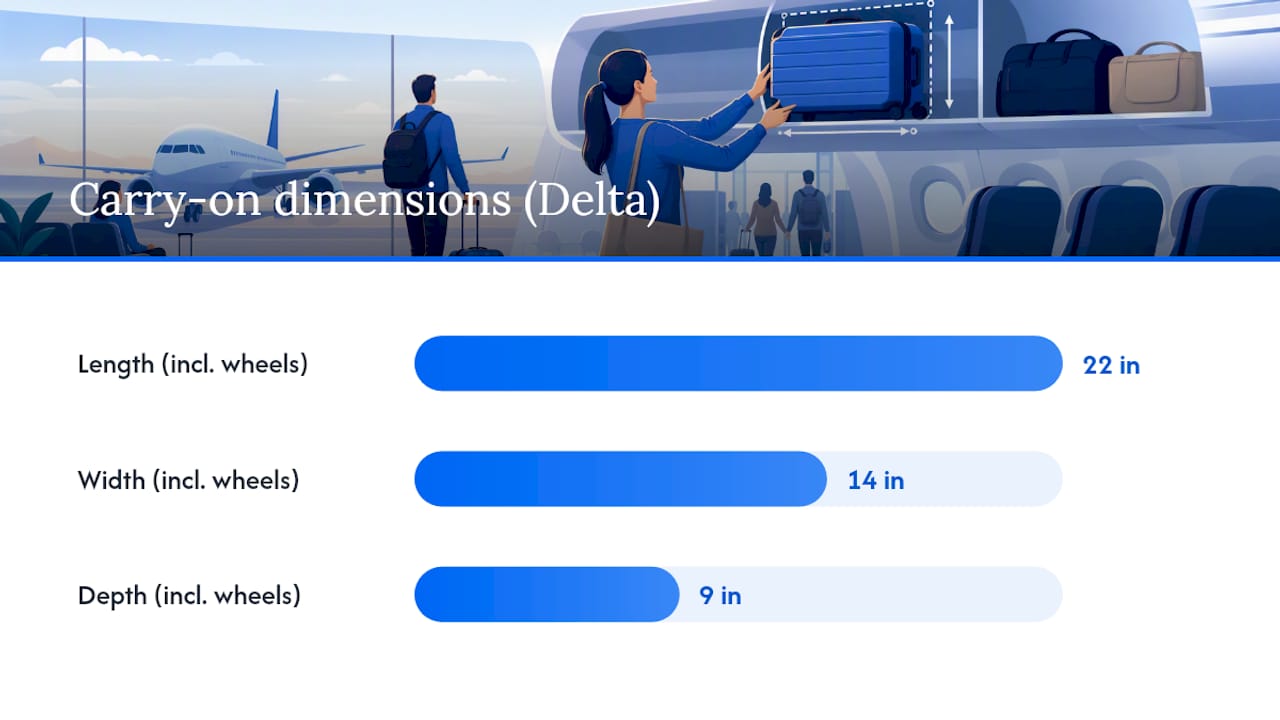
Here’s the part that trips people up: size is the rule, weight is the loophole. Delta publishes a carry-on limit of about 22 x 14 x 9 inches, and that measurement has to include the wheels and the handles, not just the fabric body of the bag. A lot of travelers measure the shell of their suitcase, forget the two inches of wheel housing sticking out the bottom, and end up gate-checking a bag they swore was compliant.
Weight works differently. Gate agents don’t have scales stationed at every boarding door. Instead, they rely on what the industry casually calls the “lift test,” meaning if you can hoist your bag overhead without looking like you’re wrestling a sandbag, nobody stops you. That changes the moment your bag looks obviously overstuffed or you struggle visibly at the jet bridge.
Before you leave the house, run through this:
- Measure your bag including wheels, handles, and any external pockets that bulge outward.
- Weigh it on a home luggage scale, not just eyeballed it.
- Check your specific fare class, since Basic Economy tickets sometimes restrict you to a personal item only.
- Confirm the rules again if any leg of your trip involves a foreign or budget carrier.
Pro Tip: Pack your heaviest items, like shoes and toiletry kits, toward the top of the bag where you can access them fast. It makes the lift test easier and speeds up security since you won’t be digging for your liquids bag at the bottom.
The U.S. Airlines That Actually Publish a Carry-On Weight Limit
Not every domestic carrier skips the weight question. A few name a specific number, and it’s worth knowing them before you show up at the counter assuming “no weight limit” applies everywhere.
| Airline | Published Carry-On Weight Limit | Note |
|---|---|---|
| Frontier Airlines | weight limit enforced, exact figure varies | Listed in Frontier’s official bag policy |
| Hawaiian Airlines | 25 lb | Enforced more closely on inter-island and long-haul Pacific routes |
| American, Delta, United, Southwest, JetBlue | No published limit | Size and lift ability govern enforcement |
Frontier and Hawaiian tend to enforce these numbers most aggressively on full flights, where overhead bin space runs out fast, and on routes flown with smaller aircraft that simply have less bin capacity per passenger. If you’re booked on either airline:
- Weigh your carry-on before you leave home, not at the counter.
- Keep a personal item genuinely small enough to slide under the seat, since agents may ask you to redistribute weight into it.
- Arrive early enough to board before bins fill, since a crowded bin increases the odds someone gets flagged for a recheck.
International Flights Change the Math Fast
Fly internationally, even on a single connecting leg, and the “just lift it” approach mostly disappears. International carriers commonly cap carry-ons between 7 and 12 kilograms, roughly 15 to 26 pounds, and airlines across Asia, the Middle East, and Europe tend to enforce those numbers with an actual scale at the gate.
This matters most on mixed itineraries. Say you fly a U.S. domestic leg with no weight enforcement, then connect onto a partner carrier overseas. The domestic leg gave you no signal about what’s coming. The international leg can still weigh your bag and make you check it, charge a fee, or ask you to shift items into your personal item bag on the spot.
Before any trip involving a non-U.S. carrier:
- Look up the specific kg/lb limit for every airline on your itinerary, not just the first one.
- Assume the strictest carrier’s rule applies to your whole trip, since gate agents on connecting flights sometimes apply it retroactively.
- Remember that low-cost international carriers enforce limits hardest, since carry-on fees are a real revenue line for them.
How Enforcement Actually Plays Out at the Gate
The lift test isn’t a formal procedure written into any airline’s contract of carriage. It’s a practical shortcut gate agents use because weighing every carry-on for every boarding passenger would grind the process to a halt. A bag draws attention when it looks dense for its size, when a passenger visibly strains lifting it, or when the overhead bins are filling up faster than expected on a full flight.
Basic Economy and other budget fare classes carry the highest real-world risk. These fares sometimes restrict you to a personal item only, and gate agents watching for oversized “carry-ons” among Basic Economy passengers tend to enforce size rules more strictly, since letting one slide invites a dozen more.
Here’s how to keep your bag off the gate agent’s radar:
- Weigh your packed bag at home with a luggage scale before you ever leave for the airport.
- Redistribute anything heavy, books, chargers, shoes, into your personal item if your carry-on feels borderline.
- Practice the actual lift, overhead-bin height, not just off the floor, so you know it’s manageable before a stranger watches you attempt it.
Pro Tip: If a gate agent does flag your bag, don’t argue the size or weight rule on principle. Ask if you can shift a few items into your personal item bag right there. It’s faster than a debate and it usually solves the problem instantly.
TSA Rules That Shape What Goes in Your Carry-On
Security screening has its own separate rulebook, and it applies no matter which airline you’re flying. The TSA’s liquids rule caps containers at 3.4 ounces (100 milliliters), and every liquid, gel, or aerosol has to fit inside one quart-sized, clear, resealable bag.
Spare lithium batteries need to travel in your carry-on, never checked luggage, due to fire risk. Devices like laptops, tablets, and portable chargers should stay easily accessible since screeners frequently ask you to remove them for separate X-ray scanning.
A few packing notes that save time at the checkpoint:
- Keep your quart bag near the top of your carry-on, not buried under clothes.
- Pack aerosol sunscreen carefully, since TSA and FAA rules on aerosol cans treat them differently from liquid sunscreen.
- Sharp objects, tools over four inches, and most sporting equipment belong in checked bags, not carry-ons.
Packing Strategies That Actually Reduce Your Risk
Meeting both size and weight rules starts with testing your bag before you ever step foot in an airport, and the process takes about ten minutes at home.
Weigh your packed carry-on on a bathroom or luggage scale first. Then do the actual lift test yourself: hoist it to shoulder height, the same motion you’d use loading an overhead bin, and hold it there for a few seconds. If your arms are shaking, so will you be at the gate.
Redistribution matters more than most travelers realize. Dense items, shoes, cosmetics, chargers, books, add weight fast without adding much visible bulk. Shifting two or three of those into your personal item bag can drop your carry-on’s weight noticeably without changing how full it looks.
Compression changes the picture differently. Vacuum-sealed packing, like Stoiq’s built-in-pump compression bags, can let you fit two to three times more volume into the same carry-on space by squeezing out trapped air. That solves a volume problem, not a mass problem. Compression won’t make your clothes weigh less, so if you’re flying an airline with a hard kilogram or pound cap, you still need to track total weight separately.
- Weigh your bag at home, every trip, not just once.
- Move dense items into your personal item when your carry-on runs heavy.
- Use compression bags to maximize what fits, but recheck total weight after compressing.
Pro Tip: Compression bags are most valuable for bulky, low-density items like sweaters and jackets. They won’t shrink the weight of a pair of hiking boots, so plan your heavy items separately.
Why Carry-On Weight Rules Differ So Much by Airline and Region
The patchwork of carry-on rules traces back to how airlines built their business models over the past two decades. Legacy U.S. carriers grew up competing mostly on network size and schedule, so overhead bin space became an operational problem, not a revenue opportunity. Their solution was simple: police the size, since a bag that fits the sizer fits the bin, regardless of what’s inside it.
International and budget carriers evolved differently. Many low-cost airlines in Europe and Asia built ancillary fees, seat selection, checked bags, and yes, carry-on weight, into their core pricing from day one. A published kilogram limit gives them a clean, enforceable line for charging extra when passengers exceed it, and it’s a far easier number to defend at a service desk than a subjective “can you lift it” judgment call.
Aircraft type plays a role too. Regional jets and smaller international aircraft carry less overhead bin volume per passenger than a wide-body U.S. domestic fleet, which pushes some carriers toward stricter enforcement simply to keep boarding on schedule. Hawaiian’s tighter enforcement on smaller inter-island aircraft reflects exactly this kind of physical constraint, not just a pricing decision.
The result is a system with no single global standard, which is exactly why checking each airline’s specific policy before departure still beats relying on general assumptions.
What Happens If Your Carry-On Is Too Heavy or Too Big
Get flagged at the gate, and the most common outcome is simple: your bag gets tagged and sent to the belly of the plane as a gate-checked item. On airlines without a published weight limit, this almost always stems from a size violation, not weight, since your bag either fits the sizer or it doesn’t.
Airlines that do enforce weight, like Frontier or international carriers with kilogram caps, may charge an overweight or oversized fee on the spot, often collected before you’re allowed to board. These fees vary by carrier and route, so there’s no single number that applies everywhere. Some airlines will offer to check the bag for free once you’ve reached the gate rather than charge a passenger already standing at the door, since it’s faster for boarding than a payment dispute.
The bigger risk is timing. A bag gate-checked at the last minute may not make it back to you at baggage claim right away if it gets diverted to a later cargo hold placement, and connecting passengers occasionally see delays retrieving gate-checked items on tight layovers. Losing access to your bag until baggage claim also means losing access to anything you packed for the flight itself, medication, chargers, a change of clothes, which is the real cost most travelers don’t anticipate until it happens to them.
Domestic vs. International: How the Rules Really Compare
Line up a typical U.S. domestic carrier next to a popular international long-haul airline, and the contrast is stark. Domestic carriers enforce a size box, roughly 22 x 14 x 9 inches, and skip weight almost entirely outside of Frontier and Hawaiian. International long-haul carriers frequently combine a similar or smaller size box with a hard weight cap between 7 and 12 kilograms, and they’re far more likely to actually put your bag on a scale.
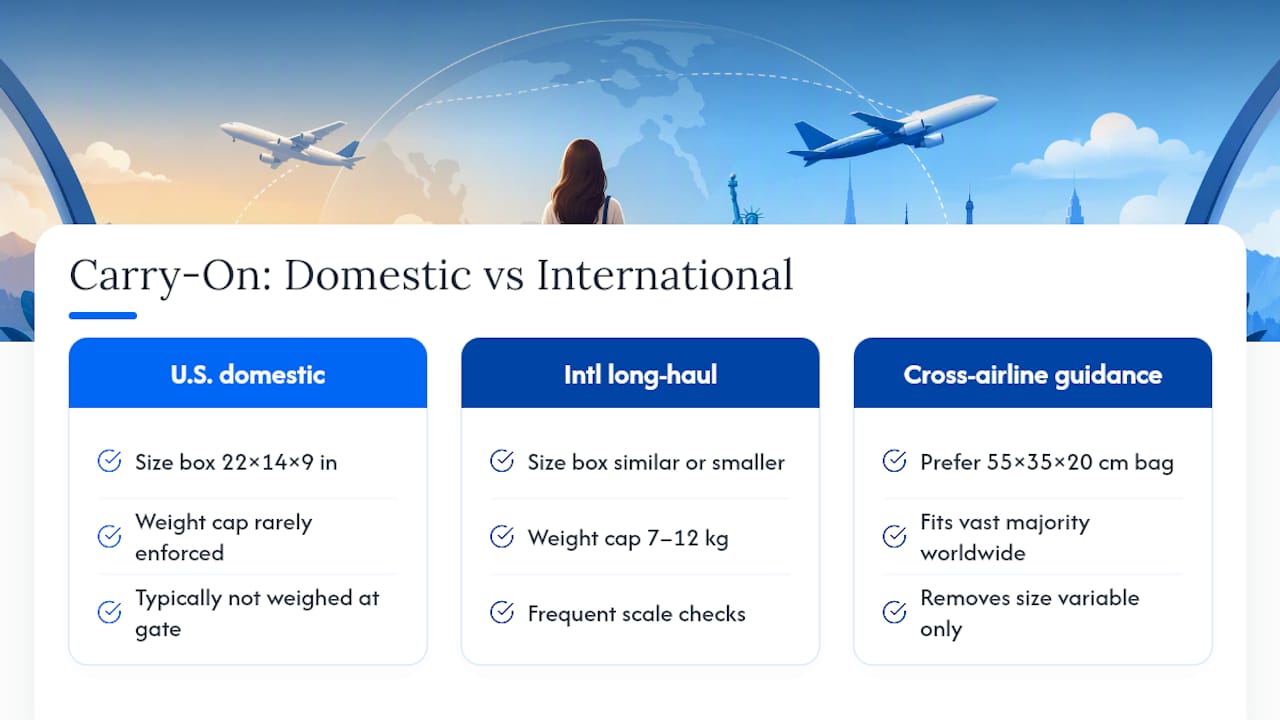
That gap creates real risk on connecting itineraries. A traveler flying a domestic leg to a hub, then connecting onto an international long-haul flight, may never get weighed on the first leg and assume the same freedom applies to the second. It doesn’t. Packing a carry-on that comfortably passes a U.S. lift test can still exceed a 10 kilogram cap on the connecting flight by a wide margin, especially once electronics, a camera, and a jacket get added in.
Choosing a carry-on sized around 55 x 35 x 20 centimeters, a dimension shown to fit the vast majority of airlines worldwide, gives you a size buffer across both types of carriers. It doesn’t solve the weight gap, but it removes one variable from an already complicated equation.
My Pre-Flight Routine After Years of Watching This Go Wrong
Three steps, every trip, no exceptions: weigh the bag, redistribute if it’s borderline, then physically practice the overhead lift before you leave the house. That last step sounds unnecessary until you’ve watched someone struggle at the jet bridge with a bag they never test-lifted at home.
If a gate agent flags your bag, know when to fold. Arguing size or weight policy with airport staff rarely goes your way and burns time you don’t have during boarding. Shift a few items into your personal item bag and move on. It’s faster and it works almost every time.
Where I’ll push back on conventional advice: most packing guides treat weighing your bag as optional. It isn’t, especially if any leg of your trip touches an international or low-cost carrier. A five-dollar luggage scale prevents more gate-check headaches than any packing hack I’ve seen recommended.
— Hugh
Where Compression Bags Fit Into Your Carry-On Strategy
Compression is a volume solution, and for most travelers, volume is the actual problem. Stoiqstorage’s vacuum bags use a built-in rechargeable pump to pull trapped air out of your packed clothing, letting you fit roughly two to three times more into the same carry-on space, based on results reported by over 20,000 Stoiqstorage customers. That’s the difference between forcing your bag shut on the way home and having room left for souvenirs.
The honest caveat: compression squeezes out air, not mass. If you’re flying Frontier, Hawaiian, or any international carrier with a published kilogram or pound cap, compressing your clothes won’t lower your bag’s actual weight on a scale. It solves the “will it fit” problem, not the “how much does it weigh” problem, so pair a Stoiq bag with an actual weigh-in before you leave home.
For travelers packing bulky layers, jackets, sweaters, workout gear, the Stoiq Carry-On Solution 20L tackles exactly that kind of volume waste. Frequent flyers who need more capacity might look at the 25L version or the Carry-On Bundle pairing a compression bag with a dedicated backpack. Check the current lineup and see which setup fits your next trip.
Sources
- Frontier Airlines — Bag options (travel info)
- KAYAK — Carry-on size guide
- TSA — Liquids/Aerosols/Gels rule
- Delta — Carry-on baggage
FAQ
What is the new carry-on size for 2026?
There’s no new universal U.S. standard yet. Most domestic carriers still hold to the long-standing 22 x 14 x 9 inch limit, measured including wheels and handles.
Is there a weight limit on carry-on bags with American Airlines?
American Airlines does not publish a formal carry-on weight limit. It enforces the standard size box and expects passengers to lift their own bag into the overhead bin without assistance.
Is the 3.4 oz rule only for carry-on bags?
Yes, the TSA’s 3.4 ounce liquids rule applies to carry-on items and personal items passing through security screening. Checked bags have no such restriction on liquid container size.
Is there a weight limit for a carry-on with United Airlines?
United Airlines does not publish a specific weight limit for carry-on bags. Like most legacy U.S. carriers, it relies on the size sizer and a passenger’s ability to lift the bag overhead.
Do compression bags help meet weight limits?
Compression bags reduce the volume your clothes occupy, letting you pack more into a carry-on, but they don’t reduce actual weight. On airlines with published kilogram or pound limits, you still need to weigh your bag separately.
