



Fit a 5–7-Day Wardrobe in One Carry-On: Compress Clothes for Travel
For most trips, the smartest approach is a hybrid: run bulky, soft items like sweaters and jeans through a vacuum or compression bag, roll casual and synthetic pieces by hand, and fold anything structured. This mix delivers the biggest space savings with the lowest wrinkle risk. One catch that trips up almost everyone is that compression shrinks volume, not weight, so a lighter-looking bag can still put you over an airline’s limit.
TL;DR:
- Compression methods like vacuum bags or compression cubes can reduce clothing volume by up to 20-30 percent, making them ideal for longer trips over four days.
- Soft, casual fabrics such as jeans, fleece, and synthetic layers tolerate pressure well, while structured garments like blazers and delicate fabrics should be kept out of compression bags.
- TSA permits vacuum storage bags and portable pumps in both carry-on and checked luggage, but bags must be checked for leaks and seals before each trip to maintain compression effectiveness.
- For a week-long trip, packing a capsule wardrobe with a hybrid of compressed, rolled, and folded clothing optimizes space without excessive wrinkle risks.
- Using gear with integrated USB-C pumps, like Stoiq bags, simplifies compression by eliminating the need for external devices and ensures packing stays within airline size limits.
Table of Contents
- What Are the Best Ways to Compress Clothes for Travel?
- How Do You Pack a Carry-On Using Compression?
- Which Clothes Should You Compress and Which Should You Skip?
- What Should You Look for in a Compression Bag or Pump?
- Does TSA Allow Compressed Clothes and Pumps Through Security?
- What Does a 5 to 7 Day Carry-On Packing Plan Look Like?
- What Do Testing and Real Use Show About Compression Bags?
- When Compression Helps and When It’s Overkill
- Pack More, Carry Less With Stoiq
- Sources
- FAQ
What Are the Best Ways to Compress Clothes for Travel?
Every method to compress clothes for travel works by squeezing air out of fabric, but each one trades speed, wrinkle risk, and gear requirements differently. Knowing which trade-off you’re making before you start packing saves you from unpacking a wrinkled mess at your destination.
Manual roll and ranger roll. Rolling is the zero-gear option. You lay a garment flat, fold the sleeves or legs in, then roll it tight from the bottom up. The ranger roll (a military packing trick) adds one more fold before rolling, which locks the roll so it won’t spring open in transit. Both methods work best on casual fabrics like cotton tees, athletic wear, and synthetic layers, and testing from Wirecutter found rolling reduces the deep crease lines that folding tends to leave behind. The downside: rolling alone rarely beats compression bags for raw volume savings, and it does nothing for structured pieces like blazers.
Packing cubes versus compression packing cubes. Standard packing cubes organize your bag into zones. Compression packing cubes go a step further with a second zipper that flattens the cube after you close it, pushing out trapped air. Pack Hacker’s testing shows compression zippers can cut volume by roughly 20 to 30 percent compared to loose packing of the same clothes. That’s a meaningful gain without the wrinkle risk of full vacuum sealing, since the compression cube’s zipper mechanism applies steady, even pressure rather than crushing everything into a flat brick.
Vacuum and compression bags. These deliver the largest volume reduction of any method, either by rolling out air manually through a one-way valve or by using a pump, hand-operated or electric, to suck air out completely. The trade-off is real: because vacuum bags compress clothing so aggressively, delicate fabrics and structured garments can pick up sharp creases that are hard to remove without steaming. You also need to manage the valve and seal carefully, since a weak seal undoes the whole point of using one.
Compression sacks for outdoor gear. Borrowed from backpacking, dry-sack-style compression sacks use roll-top closures and external straps instead of vacuum valves. They’re built from thicker, more water-resistant material than typical clothing compression bags, which makes them a better fit for camping layers, wet gear, or anything you might pack while hiking rather than flying.
Here’s how the four approaches stack up at a glance:
-
Rolling/ranger roll: No gear needed, fastest to execute, best for casual and synthetic fabrics, lowest volume savings.
-
Packing cubes (standard): Organizational tool first, minimal compression, keeps outfits grouped and easy to find.
-
Compression packing cubes: Moderate volume savings (around 20 to 30 percent), low wrinkle risk, good middle ground for mixed wardrobes.
-
Vacuum/compression bags: Highest volume savings, higher wrinkle risk for structured items, requires valve and seal maintenance.
-
Compression sacks: Durable and water-resistant, ideal for technical or outdoor gear, less suited to dress clothes.
How Do You Pack a Carry-On Using Compression?
Getting the most out of any compression method comes down to sequence. Do the steps out of order and you’ll end up repacking everything at the gate.
1. Start with a capsule wardrobe. Before you touch a compression bag, lay out everything you plan to bring and separate it into two piles: items that tolerate pressure (casual knits, jeans, synthetic layers) and items that don’t (blazers, silk, anything with embellishment). This sorting step matters more than the compression method itself, since mixing the two piles into one bag is the single most common packing mistake.
2. Compress the bulkiest soft items first. Sweaters, fleece, and jeans take up the most space relative to their weight, so they go into your compression bag or compression cube first. Roll each item loosely before placing it in the bag. Seal or zip the compression closure, then flatten by hand or pump until the air is out.
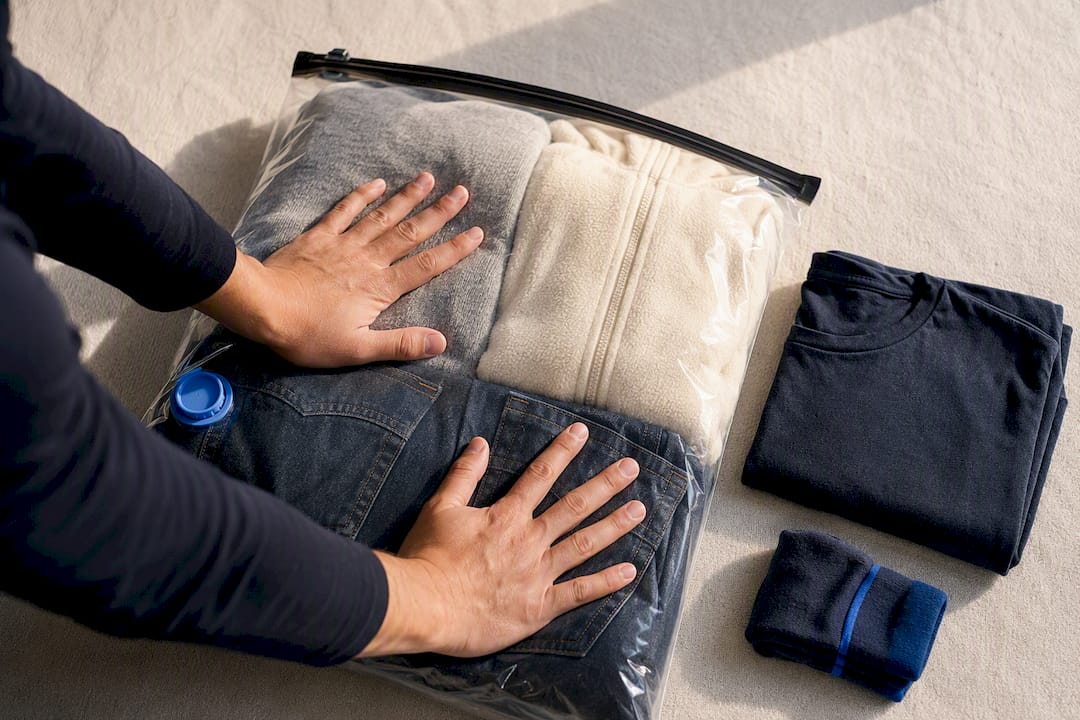
3. Roll your casual and synthetic pieces. T-shirts, workout gear, and underwear get rolled or ranger-rolled and tucked around the compressed items to fill gaps. This is also where a hybrid packing approach pays off most: rolling fills the irregular spaces a rigid compression brick leaves behind.
4. File-fold structured pieces last. Dress shirts and anything with a collar get the “file fold”: fold in thirds lengthwise, then in half, so they stand upright like files in a drawer. Lay these on top of the compressed layer where they won’t get crushed.
5. Run the final checklist before you zip the bag closed.
- Test every seal or valve by pressing gently on the bag. If air seeps back in within a minute, reseal it.
- Weigh your packed bag on a luggage scale before you leave the house, not at check-in.
- Keep one full outfit, plus a change of underwear, in an easily accessible pouch near the top of your bag.
Pro Tip: Pack your compression bags on their sides, valve or zipper facing up, so you can check the seal without unpacking the whole bag at security.
Which Clothes Should You Compress and Which Should You Skip?
Compression rewards certain fabrics and punishes others, and knowing the difference before you pack saves you from arriving with a suit that looks like it slept in a suitcase for a week, because it did.
Good candidates for compression:
- Jeans and denim, which hold their shape well under pressure and rarely crease permanently.
- Fleece and sweaters, since knit fabrics bounce back once the pressure releases.
- Synthetic base layers and athletic wear, which resist deep creasing by design.
- Casual knitwear like hoodies and cotton sweatshirts.
Garments to keep out of compression bags:
- Tailored jackets and blazers, where shoulder and collar structure can crease permanently.
- Dress shirts with starch or stiff collars, which develop sharp lines that need steaming to remove.
- Sequined, beaded, or embellished garments, which can be damaged by direct pressure.
- Delicate silks and other fine fabrics that wrinkle easily and don’t recover on their own.
Quartz’s reporting on carry-on packing techniques notes that over-compressing tailored garments can leave creasing at the shoulders and collar that’s tough to reverse without a steamer, which is exactly why frequent flyers reserve compression for the fabrics that can take it.
For the items you shouldn’t compress, you have three real alternatives. Wear the garment on travel days so it doesn’t need to be packed at all. Use a dedicated garment bag or fold it flat on top of your compressed layer. Or, if it’s swimwear or something with delicate trim, check style-specific packing guidance before deciding whether it belongs in a compression bag at all.
What Should You Look for in a Compression Bag or Pump?
Not every vacuum bag on the market holds up past a few trips, and the difference usually comes down to a handful of build details you can check before you buy.
Material and seams. Look for thicker film, generally measured in microns, along with reinforced or double-stitched seams at the corners. Thin, single-ply plastic punctures easily against zipper teeth or shoe soles packed nearby.
Zipper and valve quality. A compression bag’s zipper needs to seal fully on the first try, every time, without you needing to run your finger over it twice. The valve, whether it’s a manual roll-out design or one built for a pump, should sit flush and close with a distinct click or seal you can feel.
Pump type. You have three real options: a basic hand pump (no batteries, but slower and more effort), a separate electric pump (fast, but one more device to pack and charge), or an integrated USB-C rechargeable pump built into the bag itself. The integrated option removes the need to carry or hunt for a separate accessory, which matters most for travelers who compress bags on every trip rather than once a year.
Sizing and longevity. Match bag size to trip length rather than buying the biggest one available. Oversized bags trap more air and take longer to seal, and undersized ones force you to overstuff, which stresses seams.
Durability signals worth checking before you buy:
- A visible warranty or clear return policy, which tells you the maker expects the product to last.
- Reinforced corner seams, visible or described in product photos.
- A valve or zipper you can test in person or see demonstrated in video reviews.
- Reviews mentioning multi-trip use rather than just a single unboxing.
Even well-made vacuum bags aren’t invincible. Travel + Leisure’s multi-month product testing found that some vacuum bag sets developed minor air leakage over months of repeated use, even after strong initial compression. That’s not a reason to avoid vacuum bags. It’s a reason to check seals before every trip and treat a bag that won’t hold air anymore as due for replacement.
Does TSA Allow Compressed Clothes and Pumps Through Security?
Yes. The TSA explicitly permits vacuum storage bags in both carry-on and checked luggage, and portable pumps, including USB-C rechargeable ones, generally clear security screening as long as they don’t contain prohibited items like flammable liquids or oversized batteries. If you’re not sure how the rules apply to your specific setup, this TSA-approval breakdown for compression bags walks through the details.
A few practical habits make security smoother:
- Pack your pump somewhere accessible in your carry-on, not buried at the bottom, in case an agent wants to see it.
- Leave valves or zip seals easy to spot and reach, since a screener may ask you to open a bag for inspection.
- Know how to reseal a compression bag quickly if you’re asked to open one. Practice this once at home before your trip.
- Weigh your bag after compressing, not before. Compression makes it easier to cram in more clothes, and that extra volume adds weight you might not notice until you’re standing at the check-in counter.
That last point deserves repeating because it’s the most common misunderstanding about compression: squeezing air out of a sweater doesn’t make the sweater lighter. It just makes it smaller, which means the real risk isn’t wrinkles, it’s an overweight bag fee you didn’t see coming.
What Does a 5 to 7 Day Carry-On Packing Plan Look Like?
A concrete example beats a general rule, so here’s a wardrobe and placement plan built for a week-long trip in a standard carry-on.
Sample capsule wardrobe for 5 to 7 days:
- 3 tops (mix of casual tees and one button-down)
- 2 bottoms (one pair of jeans, one pair of travel pants or shorts)
- 1 lightweight layer (a fleece or cardigan)
- 4 to 5 sets of underwear and socks
- 1 pair of sleepwear
- 1 structured piece if needed (a blazer for business travel, worn or laid flat, never compressed)
For outfit-formula inspiration that stretches fewer pieces further, capsule packing guides built around versatile combinations can help you trim your list before you even open a compression bag.
Placement plan. The fleece, jeans, and any spare casual layers go into your compression bag first, sealed and flattened. That compressed block sits at the bottom of your carry-on, against the wheels or the rigid back panel. Rolled tees, underwear, and socks fill the gaps around and on top of that block. The button-down and blazer, folded flat using the file-fold method, sit on top of everything else where they won’t take on pressure from the layers below.
Final checklist before you head to the airport:
- Press-test every seal and valve one more time.
- Weigh the packed bag on a scale, not by hand.
- Confirm toiletries and electronics are in easy-access pouches, not buried under the compressed block.
- Set aside one emergency outfit outside the compression bag, in case your flight gets delayed and your checked layer stays sealed overnight.
What Do Testing and Real Use Show About Compression Bags?
Compression bags and packing cubes both work, but the honest picture includes limits worth knowing before you buy.
Vacuum-style compression bags can reliably cut clothing volume in half or more in short-term tests, but some sets show slow air leakage after months of repeated use, which means seal quality matters more than headline compression numbers.
One product design choice aimed at travelers who don’t want to pack a separate pump or rely on rolling air out by hand is an integrated USB-C rechargeable pump built into compression bags. The company states its bags help travelers fit 2 to 3 times more into a carry-on than traditional packing, a brand claim worth noting as such rather than an independent lab result. Feedback collected across more than 20,000 Stoiq customers points to the built-in pump as the most frequently mentioned convenience feature.
Whatever brand of bag you use, two troubleshooting habits catch problems early. First, listen for a hiss right after sealing. That’s your sign of a slow leak. Second, press each corner of the bag individually rather than the center, since corner seams fail before the middle of the bag does.
When Compression Helps and When It’s Overkill
Compression earns its place on trips longer than four or five days, or any trip where you’re deliberately trying to avoid checking a bag. For a two-night trip, rolling alone usually gets the job done, and pulling out a vacuum bag for that little laundry is more effort than it’s worth.
The mistake I see most often isn’t choosing the wrong method. It’s applying one method to an entire suitcase instead of matching each garment to what it can handle. Travelers who compress a blazer alongside their jeans, then wonder why the blazer looks slept-in at the gate, aren’t failing at packing. They’re skipping the sorting step that makes every other step work.
If you travel often enough that packing efficiency matters to your routine, learning which fabrics tolerate pressure is a better investment than buying more gear.
— Hugh
Pack More, Carry Less With Stoiq
The methods above work with any compression bag on the market, but the gear you use decides how much friction is involved in using them trip after trip. Stoiqstorage builds its bags around an integrated USB-C rechargeable pump, so there’s no separate device to pack, charge separately, or lose in a hotel drawer between trips.
Here’s what that design gets you in practice:
- No hunting for a hand pump or plugging into a wall outlet, since the pump is built into the bag.
- A sizing lineup designed around real carry-on dimensions, so the compressed load actually fits airline size limits instead of just feeling smaller.
- Feedback from over 20,000 travelers documented on the Stoiq reviews page, covering everything from baggage fee savings to how the bags hold up over repeated trips.
- Bundle options like the Carry-On Bundle pairing a compression backpack with a 25L bag for travelers who want a full one-bag system rather than piecing gear together separately.
If a week-long trip in a single carry-on sounds like the goal, start with the Stoiq Carry-On Solution 20L, check the warranty and return details on the product page, and see how much of your usual packing list actually fits.
Sources
- The 4 Best Vacuum Bags for Travel, Tested and Reviewed — Travel + Leisure
- 6 packing techniques that fit a week into a carry-on — Quartz
FAQ
Does TSA Allow Vacuum-Sealed Clothes?
Yes. The TSA permits vacuum storage bags in carry-on and checked luggage, and portable pumps without hazardous materials generally clear screening without issue.
How Do You Compress Clothes for Travel?
Use a hybrid approach: pack bulky soft items like sweaters and jeans into a vacuum or compression bag, roll casual and synthetic pieces by hand, and fold structured garments like blazers to avoid permanent creasing.
Do Compression Travel Bags Really Work?
Yes, vacuum and compression bags meaningfully reduce clothing volume, though testing shows some bags develop slow leaks over months of use, so checking seals before each trip matters.
Is It Worth It to Vacuum-Seal Clothes for Travel?
It’s worth it for trips longer than a few days or when you’re avoiding checked bags, since compression frees up meaningful space. Just remember it reduces volume, not weight, so weigh your bag after compressing to avoid baggage fees.
Do Compression Bags Work Better Than Packing Cubes?
Vacuum bags save more raw volume, but compression packing cubes offer a solid middle ground with less wrinkle risk, better organization, and no valve or seal to manage.
