



7–10 Day Prep to Organize Meds for Travel and Pass TSA
The safest way to organize meds for travel is simple: keep prescriptions in their original labeled bottles inside your carry-on, then transfer only your daily doses into a small labeled organizer for use at your destination. Pack an extra few days’ supply, carry printed prescriptions or a doctor’s letter, and know that liquid medications over the usual TSA limit are allowed if you declare them.
TL;DR:
- Always keep original labeled pharmacy bottles in your carry-on to avoid issues with unlabeled pills and customs verification.
- Use the appropriate organizer type based on your trip length and medication needs, such as a weekly tray for multiple doses or an insulated pouch for heat-sensitive drugs.
- Declare liquid medications over 3.4 ounces at TSA screening and carry necessary documentation like prescriptions and doctor’s letters to prevent delays.
- Pack extra buffer supplies in original bottles to handle unplanned delays or extended stays, especially for trips involving layovers or multiple legs.
- Keep temperature-sensitive medications in your cabin bag and use evaporative cooling wallets or gel pouches, confirming their effectiveness with a thermometer strip.
Table of Contents
- What Should Be On Your Medication Packing Checklist?
- Which Type of Travel Medication Organizer Fits Your Trip?
- What Are the TSA Rules for Traveling With Medication?
- How Do You Protect Temperature-Sensitive Medications While Traveling?
- What’s the Step-by-Step Process for Packing Medication?
- How Do You Choose the Right Medication Organizer for Your Trip?
- A Frequent Traveler’s Take on What Actually Works
- An Editor’s Take on Medication Organization for Travel
- How Stoiq’s Travel Systems Keep Your Medications Accessible
- Sources
What Should Be On Your Medication Packing Checklist?
A good travel medicine organizer setup starts with a checklist you actually follow, not one you screenshot and forget. Before you zip anything closed, confirm you have these items ready:
- Original pharmacy bottles for transit and customs
- A small daily pill organizer for day-to-day use once you arrive
- A printed prescription list with generic drug names and dosages
- A doctor’s letter if you’re carrying controlled substances
- Spare doses covering several extra days
- OTC basics: pain reliever, antihistamine, anti-diarrheal
- A portable sharps container if you use needles or syringes
- A thermometer strip or small cooler for temperature-sensitive meds
Everything above belongs in your carry-on, never in checked luggage. Keep the daily organizer in an easily reachable spot, like a top pocket or a dedicated toiletry pouch, so you’re not digging through a packed bag at 6 a.m. in an airport line. This approach aligns with the principles discussed in why travel skincare simplification matters for trips, emphasizing streamlined packing for hassle-free travel. Label every organizer compartment with the drug name and dose, keep medication receipts or monographs in a clear zip pocket, and separate liquids into their own sealed bag before screening.
Which Type of Travel Medication Organizer Fits Your Trip?
Not every trip calls for the same setup, and that’s where most travelers overpack or underprepare. The right medicine bag for travel depends on how many doses you take daily and how long you’re gone.
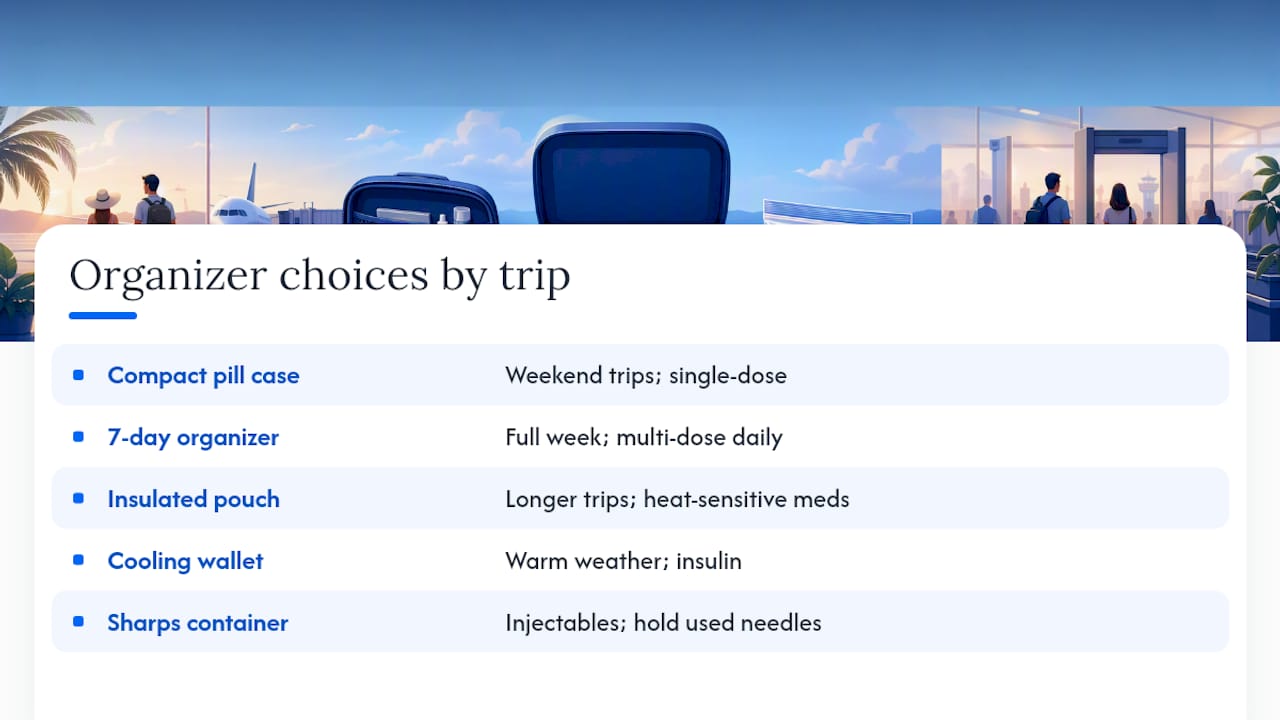
A compact travel pill case works best for single-dose regimens. It’s small enough to drop in a jacket pocket and gives you quick access without digging through a bag. A 7-day AM/PM pill organizer makes more sense for multi-dose daily schedules, since pre-sorting a full week of pills into a weekly tray cuts down on dosing errors and keeps your routine steady even when your schedule doesn’t feel steady at all.
If you’re carrying insulin, biologics, or anything heat-sensitive, an insulated medication travel bag or insulated pouch adds a layer of protection that a plain pill case can’t offer, though it takes up more room. A cooling wallet, whether evaporative or gel-based, is worth the extra ounce for insulin on warm-weather itineraries. And if you inject medication, a portable sharps container isn’t optional. Pack an empty one for used needles until you reach a proper disposal point.
Pro Tip: For a weekend trip, a compact pill case alone usually covers it. For a full week, pair a 7-day organizer with your original bottles. For anything longer or involving injectables, add an insulated pouch and a sharps container to the mix.
What Are the TSA Rules for Traveling With Medication?
You can pack an unlimited amount of solid medication in your carry-on, and TSA also allows medically necessary liquids over the standard 3.4-ounce limit, as long as you declare them at screening. Expect additional inspection when you do.
Keep the essentials in mind before you reach the checkpoint:
- Solid medications (pills, capsules) face no quantity limit in carry-on bags
- Liquid meds over 3.4 ounces are allowed but must be declared to the officer
- You can request a visual inspection instead of X-ray screening if you’d rather not run your medication through the machine
- Original labeled containers are strongly recommended for international travel and customs checks
Customs officers cannot reliably verify unlabeled loose pills, which is exactly why keeping originals for transit matters even if you plan to switch to a daily organizer once you land. Bring a printed prescription list with generic names, a physician’s travel letter for any controlled substances, and copies of your prescriptions. The TSA’s own guidance on packing pill cases and declaring liquids covers most of the edge cases you’ll run into at the checkpoint.
How Do You Protect Temperature-Sensitive Medications While Traveling?
Checked baggage holds can swing to damaging extremes, which is reason enough to keep insulin, inhalers, and other heat-sensitive drugs in your carry-on rather than trusting them to cargo. Once you’re on the ground, the challenge shifts to managing heat during transit, not just avoiding the cargo hold.
Evaporative cooling wallets, which you soak and reactivate rather than plug in, work well for extended travel days because they don’t rely on electricity or ice. Pharmacist-recommended cooling wallets in this style hold up over long layovers better than a standard ice pack, which starts losing effectiveness within a few hours. Insulated pouches with gel packs are the sturdier, bulkier alternative, and a thermometer strip tucked inside either option lets you confirm your medication never crossed into unsafe territory.
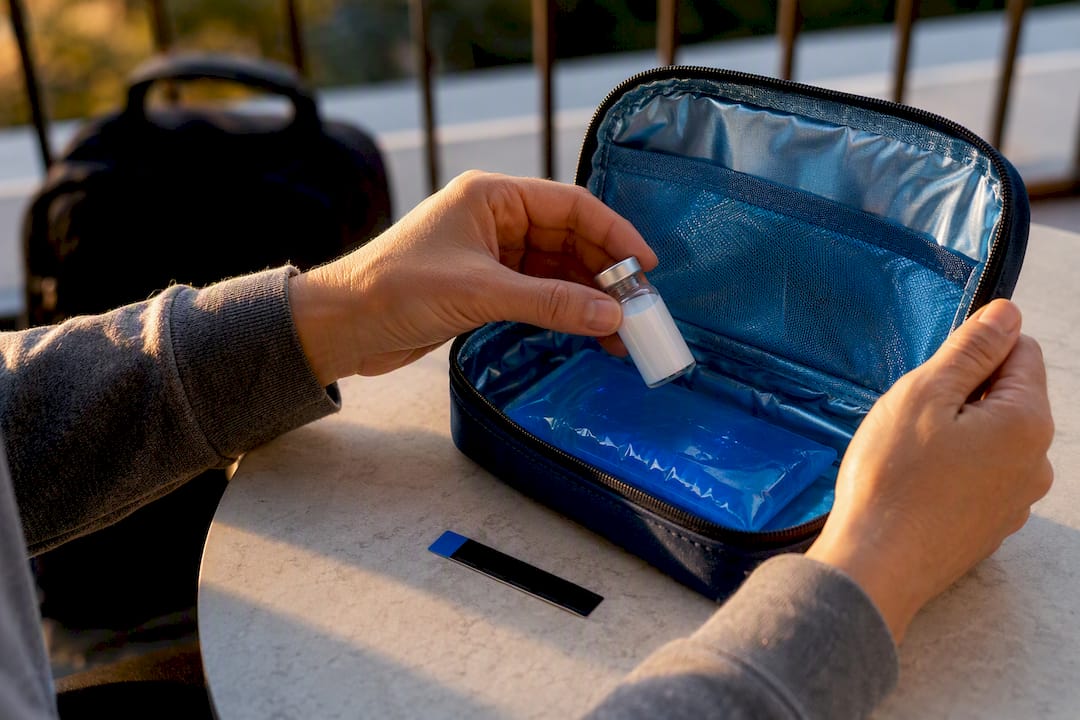
Pro Tip: Swap your ice pack right before boarding, never leave medication in a parked car even briefly, and if you’re unsure how a specific drug tolerates heat, call your pharmacist before you fly, not after.
What’s the Step-by-Step Process for Packing Medication?
Building your system in stages, rather than the night before your flight, cuts down on the scramble.
- 7 to 10 days before departure: Confirm refills with your pharmacy, request extra supply if your plan allows it, and print a medication list with generic names and dosing times.
- 48 hours before: Assemble your original bottles alongside your daily organizer, pack your OTC kit, and prepare a physician’s letter if you’re carrying controlled substances.
- While packing: Place all medication in an easy-access carry-on compartment, tuck the daily organizer into a small zip pouch, and secure any sharps in an approved container.
- During travel: Declare medically necessary liquids at screening, keep essential meds on your person rather than in an overhead bin, and set phone alarms to keep dosing on schedule across time zones.
That last step matters more than people expect. A dose scheduled for 8 a.m. at home doesn’t automatically adjust when you land six time zones away, and pill organizers don’t fix that on their own. Phone alarms do.
How Do You Choose the Right Medication Organizer for Your Trip?
Match the organizer to how you actually travel, not to what looks organized on a shelf. Run every option against the same criteria: how many doses it holds, how easily it fits in a carry-on pocket, whether it protects against heat, whether it clears TSA screening without friction, and what it costs against how often you’ll use it.
For most short trips, a compact multi-compartment pill case covers single-dose regimens without adding bulk. Anyone managing multiple daily doses over a week benefits from a 7-day AM/PM tray instead, since it keeps every dose pre-sorted and visible. Travelers with insulin, biologics, or other heat-sensitive prescriptions should add an insulated med pouch or, for longer trips, an evaporative cooling wallet that doesn’t depend on ice or an outlet. Anyone using injectables needs a portable sharps kit, full stop. That one isn’t a nice extra.
When you’re comparing physical organizers, favor ones with durable zippers, water-resistant material, clearly labeled sections, and removable trays you can rinse out. And buy from a retailer with a real return policy. A $12 organizer that falls apart after two trips isn’t a bargain.
A Frequent Traveler’s Take on What Actually Works
The biggest mistake happens on multi-leg trips, not straightforward round trips. Connections get missed, layovers stretch into overnight stays, and a daily organizer packed for a tidy three-flight itinerary suddenly needs to stretch an extra day with no pharmacy in sight. The fix that’s saved more than one trip: always pack the buffer supply in the original bottle, not pre-sorted into the organizer, so an unplanned extra day doesn’t mean scavenging loose pills from a case that wasn’t built for it.
, and
A renamed zip pocket, one set aside specifically for medication receipts, dosage printouts, and the physician’s letter, sounds minor, but it’s the difference between a five-second customs check and a ten-minute conversation with an officer who wants proof of what you’re carrying.
An Editor’s Take on Medication Organization for Travel
Most advice on this topic treats medication organization like a packing hack, something to optimize the way you’d optimize a shoe layout in a suitcase. That framing undersells what’s actually at stake. Getting this wrong doesn’t just mean a bulkier bag. It means a confiscated liquid at security, a customs officer squinting at unlabeled pills, or an insulin vial that’s degraded in a hot cargo hold by the time you land.
The conventional wisdom oversells the organizer itself and undersells the system around it. A well-labeled weekly tray means nothing if your original bottles are buried in checked luggage or your buffer supply ran out on day four of a delayed trip home. Prioritize the boring parts first: labeled originals, a printed prescription list, and a real buffer of extra days. The organizer is the last five percent, not the first.
Where most people go wrong is assuming one product solves everything. It doesn’t. A compact pill case, a cooling wallet, and a sharps container solve three separate problems, and skipping any one of them because “the trip is short” is exactly how the short trips go sideways.
— Hugh
How Stoiq’s Travel Systems Keep Your Medications Accessible
An organized medicine bag for travel doesn’t have to compete for space with your clothes, and that’s where a compression system earns its keep. Stoiq’s toiletry bags and vacuum compression bags are built around the same principle your medication kit needs: keep essentials accessible while everything else stays compressed and out of the way.
The Stoiq Toiletry Bag gives your daily pill organizer, thermometer strip, and prescription printouts a dedicated compartment, separate from the compressed clothing in your main bag. Pair it with the Stoiq Carry-On Solution 20L, and the built-in USB-C rechargeable pump means you’re not hunting for a separate vacuum device at 5 a.m. before a flight. Over 20,000 travelers have used Stoiq’s compression system to fit two to three times more into a single carry-on, which leaves more room for the insulated pouch or cooling wallet your medication actually needs. Check the Stoiq reviews page for real feedback, then see how the 20L bundle fits your next trip.
Sources
This guide draws on official screening rules and clinical travel guidance rather than general packing blogs:
- Travel tips — TSA
- Traveling with medication: a pharmacist’s guide to customs, storage & refills (2026) — Mindful Travel & Health
This article is general information, not a substitute for advice from a qualified doctor. Consult a qualified healthcare professional about your own circumstances before acting on anything here.
