


Personal Item vs Carry On: The Real Rules for 2026
A personal item is the smaller bag that fits under the seat in front of you; a carry-on is the larger bag that goes in the overhead bin. Most standard fares let you bring one of each for free, but basic-economy tickets and oversized bags are where the fees show up. Measure both bags before you leave for the airport, and pack your flight-critical items into the personal item.
TL;DR:
- Most airlines publish strict size limits for personal items around 17 x 10 x 9 inches, including wheels and handles, which travelers often measure incorrectly.
- Basic economy fares typically restrict passengers to only a personal item, requiring checked bags for larger belongings, often at higher fees.
- Mid-size backpacks between 18 to 25 liters are judged case by case, with smaller ones accepted as personal items and larger as carry-ons.
- Packing tips suggest placing essential items needed within 30 minutes in the personal item and using compression tools to maximize space in carry-ons.
- Gate-checks often happen due to actual overhead bin space rather than measurement violations, especially on smaller aircraft or late boarding groups.
Table of Contents
- What Counts as a Personal Item vs. a Carry-On?
- How Big Can a Personal Item or Carry-On Actually Be?
- Does Your Fare Class Change Your Carry-On Allowance?
- What Goes in Your Personal Item vs. Your Carry-On?
- Why Do Bags Get Gate-Checked Even When They Fit the Size Limit?
- What I’ve Learned About Splitting a Carry-On and Personal Item
- Get More Out of Your Carry-On With Stoiq
- Where to Verify the Rules Before You Fly
- Sources
What Counts as a Personal Item vs. a Carry-On?
A carry-on is built for the overhead bin. Think roller suitcases, large duffels, and backpacks big enough that they will not slide under a standard economy seat. A personal item is built to live at your feet: purses, laptop bags, small backpacks, and dedicated under-seat luggage.
The line gets fuzzy with backpacks, which is exactly why so many travelers get stopped at the gate. A 20 liter daypack usually passes as a personal item. Push past 30 liters, or add external straps and a rigid frame, and gate agents will often reclassify it as a carry-on. Hard-shell under-seat luggage causes similar confusion. It is marketed as a personal item, but if it does not actually compress or flex to slide under the seat in front of you, it can get treated as a second carry-on.
Practical distinctions worth remembering:
- Carry-on: roller suitcase, large backpack, garment bag, soft duffel over roughly 20 liters.
- Personal item: purse, laptop bag, diaper bag, small backpack, structured under-seat luggage.
- Gray zone: mid-size backpacks (18 to 25 liters), which airlines judge case by case at the gate.
Travel writers at The Manual note that backpacks routinely get treated as personal items when small and as carry-ons when large, which is really a shape-and-fit test more than a strict volume rule.
How Big Can a Personal Item or Carry-On Actually Be?
Airlines publish carry-on limits far more consistently than personal-item limits, and the gap between the two matters more than most travelers realize. United Airlines sets its carry-on at 9 x 14 x 22 inches (23 x 35 x 56 cm), including any wheels or handles that stick out. Its personal item maxes out at 9 x 10 x 17 inches (22 x 25 x 43 cm), small enough to slide flat under most economy seats.
| Bag type | Typical dimensions | Where it goes | Counts wheels/handles? |
|---|---|---|---|
| Carry-on | 22 x 14 x 9 in | Overhead bin | Yes |
| Personal item | 17 x 10 x 9 in | Under the seat | Yes |
Those numbers vary by airline and even by aircraft, so treat them as a starting range, not a universal standard.
Statistic to know: United’s published carry-on cap of 9 x 14 x 22 inches includes the handle and wheels, not just the fabric shell. That single detail trips up more travelers than any other packing mistake, because a bag that “measures” fine on a store tag can run an inch over once you account for the wheel housing.
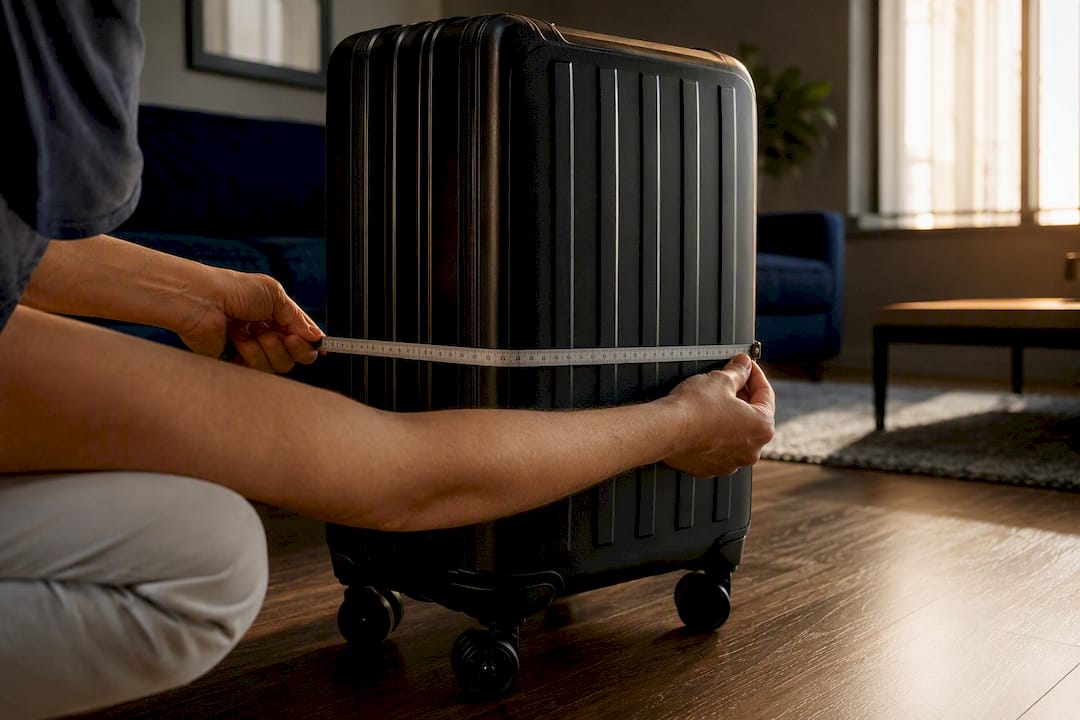
Measure with a tape, not by eye, and pull the tape to the farthest protruding point, whether that is a wheel, a zipper pull, or a side pocket stuffed too full. American Airlines and other major carriers describe personal items more loosely, often just saying the bag needs to “fit under the seat in front of you” rather than listing exact inches. When a carrier skips the numbers, assume the strictest range and test-fit your bag against a kitchen chair before you pack it full.
Does Your Fare Class Change Your Carry-On Allowance?
Standard economy fares on most U.S. carriers include one carry-on and one personal item at no extra charge. Basic economy is where that changes. Several major airlines restrict basic-economy passengers to a personal item only, according to The Points Guy’s rundown of airline carry-on policies, which means the roller bag you assumed was included has to be checked, often at the gate for a higher fee than if you had prepaid.
Fee triggers to watch for:
- Booking basic economy and showing up with a full-size carry-on.
- A personal item that runs even an inch over the airline’s stated limit.
- Bringing a second bag beyond your allowance, even a small one.
- Waiting until boarding to discover your bag does not fit the sizer.
Pro Tip: Check your specific fare class on the airline’s own baggage page the same week you fly, not when you booked. Policies and fees change more often than travelers expect, and a rule from six months ago may already be outdated.
Prepaying for a checked bag online almost always costs less than a gate-check fee. If you are flying basic economy and know your personal item will not hold everything, price out a checked bag in advance rather than gambling on space at the gate.
What Goes in Your Personal Item vs. Your Carry-On?
Pack with a simple test: if you would panic without it for 30 minutes, it belongs in your personal item, especially when using travel-friendly fitness gear that fits easily inside.
- Personal item: travel documents, wallet, phone, medications, chargers, valuables, a snack, and any small electronics you will use in flight.
- Carry-on: clothes, shoes, bulkier toiletries within TSA’s 3.4 ounce liquid limit, spare chargers, and anything you do not need until you land.
- Space tactics: wear your bulkiest jacket instead of packing it, roll rather than fold soft clothing, and use packing cubes or compression tools to shrink garments that eat the most volume.
A 3-compartment toiletry bag keeps liquids organized and TSA-compliant without eating your personal item’s limited space, and it makes bin checks faster when a screener asks you to pull it out separately.
Pro Tip: Pack one full change of clothes and any daily medication in your personal item, not your carry-on. If your carry-on gets gate-checked, you still have what you need until baggage claim.
Why Do Bags Get Gate-Checked Even When They Fit the Size Limit?
A bag can meet every published dimension and still get gate-checked. Gate agents make that call based on how full the overhead bins actually are, not just your bag’s measurements, and a smaller regional aircraft simply has less bin space than a wide-body jet. Simple Flying’s coverage of carry-on enforcement points out that boarding order matters here: later boarding groups face a real risk that bins fill before they reach their row.
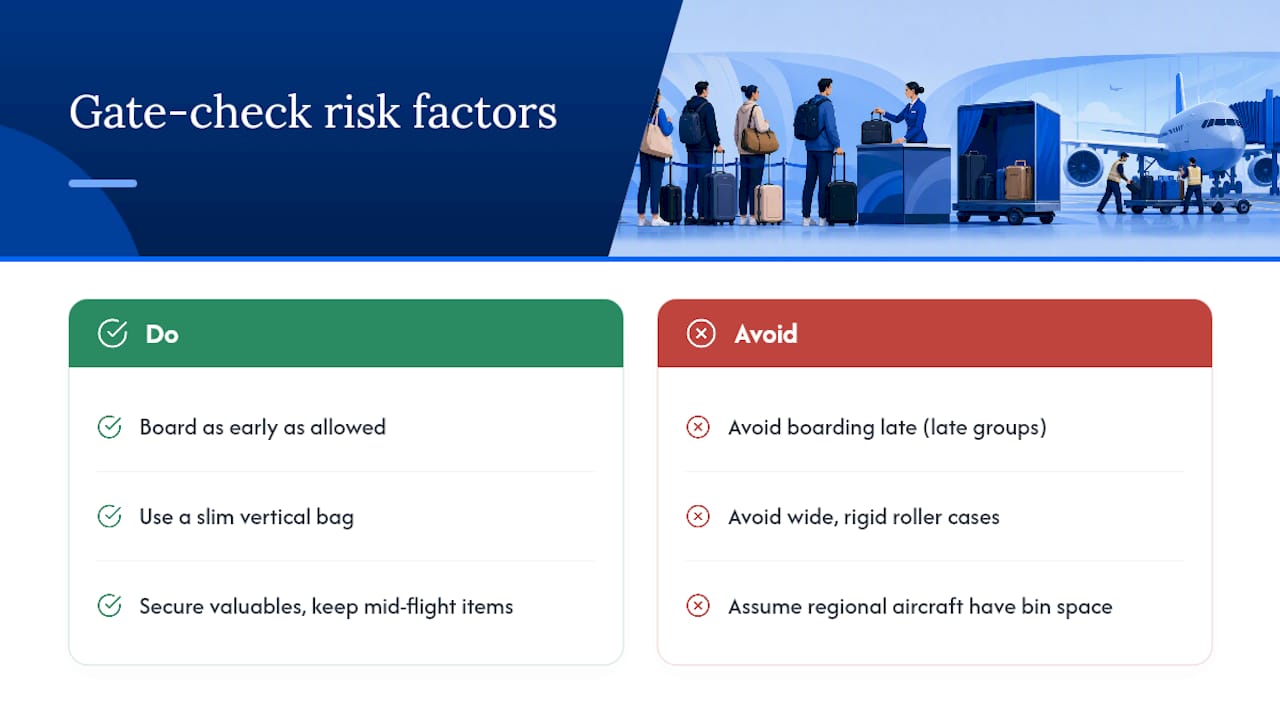
Slim, vertical bags also fare better than wide, rigid roller cases, even when both technically hold the same volume, because they slot into leftover bin gaps more easily. Boarding as early as your group allows cuts your odds of a gate check. If you do get tagged, secure valuables and pull anything you need mid-flight into your personal item first.
What I’ve Learned About Splitting a Carry-On and Personal Item
Deciding which bag holds what comes down to one question: what do you need before your carry-on is out of reach? I have watched compression bags turn a stuffed, overweight duffel into a carry-on that still zips flat, saving a checked-bag fee on the spot at check-in. That single swap, more than any packing hack, is what actually prevents fee surprises. Travelers who treat their personal item as a lifeline, not an afterthought, are the ones who never scramble at the gate.
— Hugh
Get More Out of Your Carry-On With Stoiq
Fitting everything into one carry-on and one personal item usually means sacrificing half your wardrobe, unless you compress what you pack instead of just folding it tighter. Stoiqstorage’s vacuum compression bags use a built-in rechargeable pump to pull excess air out of your clothes, letting travelers pack roughly 2 to 3 times more into the same carry-on space without adding weight anywhere near a checked-bag fee threshold.
The Stoiq Carry-On Solution 20L works well for anyone flying basic economy who needs a full carry-on’s worth of clothing to fit into a strict personal-item budget. Bulky travelers, like anyone packing winter layers or gear for a two-week trip, tend to see the biggest space gains. If you prefer a wearable personal item instead, the Stoiq Compression Backpack compresses on your back rather than in a stowed bag. Before you pack a compression bag, double check TSA’s rules on carry-on liquids and prohibited items so nothing you compress gets pulled at screening. Head to the Stoiq Carry-On Solution page to check sizing against your next flight before you book a checked bag you did not need.
Where to Verify the Rules Before You Fly
Airline baggage policies shift often enough that this article should be your starting point, not your final word. Check TSA’s official guidance on allowed items, review your specific carrier’s carry-on page, and confirm your fare class’s exact allowance before your trip.
