



Match Your Packing Routine: 3 Compartment Toiletry Bag for Travelers
For most travelers, a medium divided or semi-rigid toiletry bag hits the sweet spot between visibility, spill protection, and packability, while flat single-compartment bags win on flexibility and hanging bags win on limited counter space. Modular pouch systems suit complicated routines with multiple products. Whatever style you pick, remember your liquids over 3.4 ounces still need to fit a clear quart bag under TSA rules.
TL;DR:
- Medium divided or semi-rigid toiletry bags offer a balanced mix of visibility, spill protection, and packability for most travelers.
- Internal features like mesh pockets, elastic loops, and clear wet pockets help organize liquids, small items, and fragile containers effectively.
- Choosing a three-compartment bag with a semi-rigid structure improves quick access, spill containment, and protection against travel damage.
- Pack liquids in designated compartments or pouches, keep your quart bag accessible, and double-check internal dimensions before purchasing.
- Match your toiletry bag’s layout to your travel routine, avoiding overpacking to prevent clutter and leaks during trips.
Table of Contents
- Toiletry Bag Compartments Explained: The Main Styles
- How Compartment Design Changes What You Can Pack and How Fast
- What to Prioritize When Choosing Compartment Features
- Packing and Maintenance Habits That Make Any Bag Work Better
- How a 3-Compartment Design Solves Real Packing Problems
- Which Compartment Style Actually Fits Your Trip
- A Compact Toiletry Bag That Matches This Guide’s Criteria
- Sources
Toiletry Bag Compartments Explained: The Main Styles
Every toiletry bag on the market falls into one of five design families, and once you can name them, shopping gets a lot faster. Wirecutter’s testing across dozens of bags found the same pattern: most products are variations on single compartment pouches, divided or semi-rigid kits, and hanging organizers, and no single layout works for every traveler. Here’s what separates them.
Flat or single-compartment bags are exactly what they sound like: one open pocket, maybe a small interior sleeve, and a zipper. They’re light, they compress flat in a suitcase, and they’re the easiest style to squeeze into a half-full carry-on. The trade-off is obvious the first time you dig for your contact lens case at the bottom of a pile of tubes and bottles. These bags work best for minimalist packers with five or six items who don’t mind a quick rummage.
Divided or multi-pocket bags add internal structure: separate zippered sections, mesh dividers, or stitched-in slots that keep your toothbrush away from your razor. This is the category most reviewers land on as the practical middle ground, and Forbes’ product roundup echoes that consensus, calling medium divided bags the best compromise for travelers who want organization without hauling a rigid case.
Semi-rigid dopp kits take that structure further with a stiffened frame or reinforced base that lets the bag stand upright on a counter. Structured designs protect glass containers and cosmetics from getting crushed in a way soft pouches simply can’t, which matters if you’re traveling with a real perfume bottle instead of a travel spray.
Hanging bags unzip (often on three sides) to reveal a flat panel of pockets you hang from a hook, shower rail, or towel bar. Wired’s testing notes point out the appeal: everything is visible at once, nothing gets buried, and you’re not hunting through layers. The catch is real. A hanging bag with nowhere to hang it is just an awkward flat bag on a bathroom counter, and that’s a common failure point in older hotels, Airbnbs, or cruise cabins with no rail space.
Modular pouch systems ditch the single-bag idea entirely in favor of two or three smaller pouches you mix and match. Modular setups scale to trip length, so a weekend trip means grabbing one pouch, while a three-week trip means packing all of them. The downside is more items to track and zip closed individually.
Inside any of these styles, you’ll run into the same set of internal features again and again:
- Mesh pockets for quick-drying items like loofahs or razors
- Elastic loops that hold pens, brushes, or thin tubes upright
- Clear vinyl “wet pockets” for a damp toothbrush or soap bar
- Dedicated toothbrush sleeves that keep bristles off other items
- Zippered interior dividers for pills, jewelry, or anything you don’t want loose
Pro Tip: If you’re torn between styles, picture your last hotel bathroom. If you kept setting things down on a towel because there was no counter space, you need a hanging bag. If you had plenty of counter but kept losing small items in your dopp kit, you need better internal dividers, not a bigger bag.
How Compartment Design Changes What You Can Pack and How Fast
The layout you choose doesn’t just affect how a bag looks. It changes how quickly you can grab what you need and how much risk you’re carrying if a cap loosens mid-flight.
Vertical pockets, the kind you find in hanging organizers, let you scan everything in one glance because each item gets its own slot at eye level. Stacked layers, common in flat and modular bags, save space but cost you time. You end up unpacking three items to reach the fourth. Wirecutter’s testing found that semi-rigid pouches with a wide U-shaped opening solve this problem without needing to hang anything. A wide mouth on a structured base gives you nearly the same at-a-glance access as a hanging bag, minus the dependency on a hook.
Structured walls do more than help access. A rigid or semi-rigid frame keeps glass bottles, pressed powder compacts, and anything else fragile from taking a direct hit when a suitcase gets tossed onto a baggage cart. Soft, flat pouches flex with the bag around them, which is great for squeezing into a tight carry-on gap but bad news for anything that shatters or cracks under pressure.
Then there’s the quart bag question, which trips up more travelers than it should. The TSA 3-1-1 rule requires carry-on liquids in containers of 3.4 ounces or less, all inside one clear quart-sized bag presented separately at security. That quart bag has to live somewhere accessible, and your toiletry bag’s layout determines how painless that is:
- If your bag has a dedicated outer pocket, keep the quart bag there so you can pull it out without unpacking anything else.
- If your bag is a single flat compartment, pack the quart bag last, on top, so it’s the first thing your hand touches.
- If you’re using a modular system, designate one small pouch as the quart-bag pouch every trip so you stop guessing which one has it.
Leak prevention comes down to habits more than hardware. Tighten every cap a quarter turn past where it feels done. Slip a small square of plastic wrap under lids on liquids you’re not using immediately, especially shampoo and conditioner, since pressure changes in cargo holds cause more leaks than most people realize. Pack a folded microfiber cloth or an old sock in the bag’s bottom seam. It won’t stop a leak, but it will stop that leak from reaching your clothes.
Pro Tip: Keep your quart bag in the same pocket every single trip. The few seconds you save at a TSA checkpoint by not fumbling for it add up over a year of travel.
What to Prioritize When Choosing Compartment Features
Shopping for a new toiletry bag gets a lot simpler once you’re checking against a short list instead of comparing every bag’s marketing copy. A useful feature framework from Purevave makes a point worth repeating: more pockets are not automatically better. Pocket utility depends entirely on size and placement, not count.
Here’s what actually moves the needle:
- Capacity and pocket sizing. Count your actual items, not a hypothetical packing list, and match pocket size to your real bottle sizes. A bag with eight pockets that are all too small for a standard 3-ounce bottle is worse than a bag with four pockets sized correctly.
- Opening style. A full unzip that lays the bag flat gives you the most access but takes up the most counter space. A top-only zipper keeps a small footprint but slows down access to anything at the bottom.
- Hook quality on hanging bags. Look for a thin, rubber-tipped hook. Wired’s reviewers noted that hook design is a small detail with outsized impact, since a thick or metal hook can slip off narrow towel rails or scratch bathroom fixtures.
- Material and liner type. A wipe-clean lining, usually a coated nylon or TPU, means a leaked bottle is a thirty-second cleanup instead of a laundry problem.
- Packability versus weight. A flat bag adds almost no weight or bulk to your carry-on. A structured case protects more but takes a fixed chunk of space whether it’s full or half-empty.
Watch for a few red flags before you buy. Thin mesh pockets that stretch out of shape after a handful of uses. Zippers with no pull tab, which get harder to grip with wet or lotion-covered fingers. And bags marketed on pocket count alone with no photos of actual pocket dimensions.
Pro Tip: If a product listing doesn’t show interior dimensions or a photo of the bag actually packed, assume the pockets are smaller than they look in the hero shot.
Packing and Maintenance Habits That Make Any Bag Work Better
A good compartment layout only helps if you pack it with a system. Organizing by category rather than by whatever you grab first cuts down on spills and speeds up access, and it works in almost any bag style.
- Sort into three groups before you pack: essentials you’ll use daily (toothbrush, deodorant, contacts), situational items you might need (sunscreen, bug spray, pain reliever), and backups you hope you don’t (extra contact solution, a spare razor). Essentials go in the most accessible pocket. Situational items go in secondary pockets. Backups go at the bottom or in a modular pouch you rarely open.
- Layer heaviest and least leak-prone items on the bottom, lighter and higher-risk items on top, so a leak drips down onto something washable rather than seeping into your only tube of toothpaste.
- Add a secondary barrier for anything liquid. A small zip-seal bag or a folded absorbent cloth around a shampoo bottle catches a leak before it reaches fabric.
- Wipe down the lining after every trip. Coated nylon and TPU linings clean up with a damp cloth and a drop of dish soap. Leather trim needs a dry cloth and an occasional leather conditioner, never a soaking wipe-down.
- Store the bag upright inside your suitcase, wedged against a firm side rather than loose in the middle, so it doesn’t tip and redistribute weight onto your clothes mid-flight.
How a 3-Compartment Design Solves Real Packing Problems
A well-built three-compartment toiletry bag is a practical case study in why layout matters more than pocket count. Stoiqstorage’s 3-compartment toiletry bag uses a wipe-clean interior lining and a semi-rigid structure that lets it stand upright on a counter without tipping, which solves the two most common complaints travelers have about dopp kits: slow access and spill cleanup.
Picture two travelers with different problems. One is flying with a single carry-on and needs every item reachable in seconds during a tight layover; a compact three-compartment layout means essentials, situational items, and backups each get their own zone without adding bulk to the bag. The other is checking a bag on a two-week trip and worried about a shampoo bottle bursting under cabin pressure changes; a wipe-clean lining turns a potential laundry disaster into a quick wipe-down at the destination.
The best bag doesn’t force you to change how you pack. It adapts to the routine you already have, whether that’s three products or fifteen.
Pro Tip: Test any new toiletry bag at home first. Load it exactly how you’d pack for a real trip, then try to find your toothbrush with your eyes closed. If you can’t, the layout doesn’t match your routine yet.
Which Compartment Style Actually Fits Your Trip
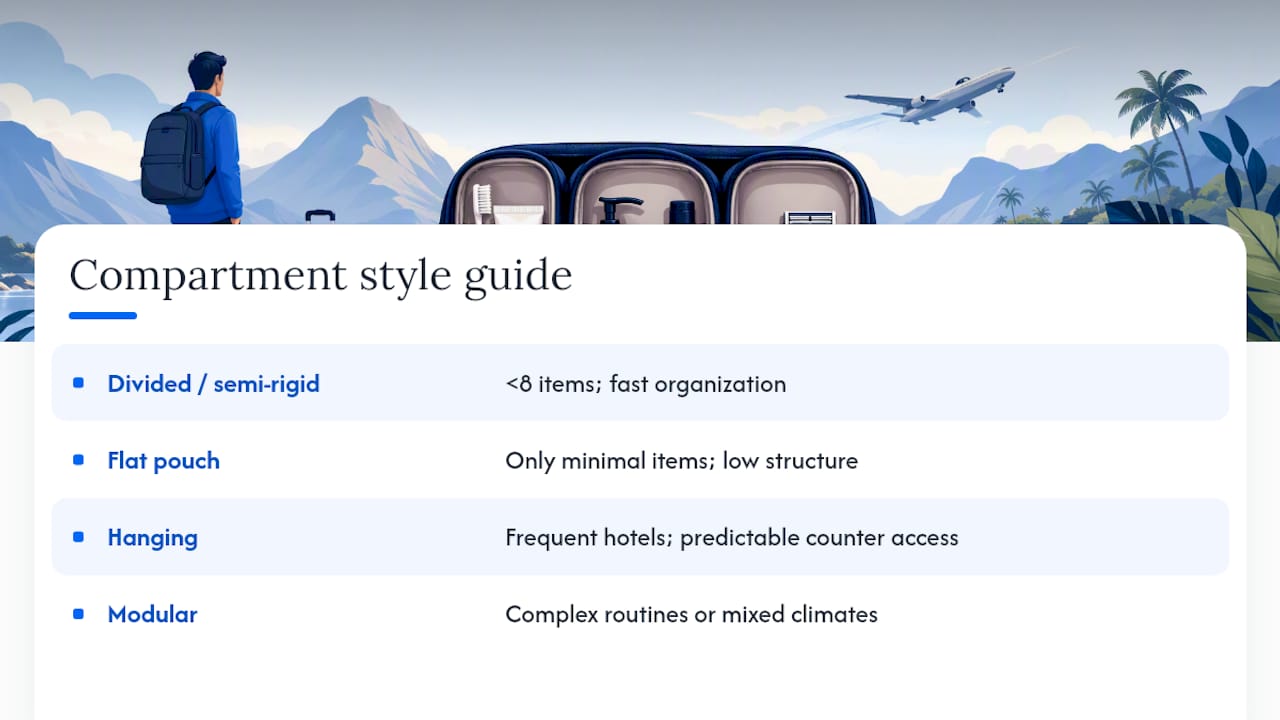
Most travelers overthink this decision. If you pack fewer than eight items and value speed over structure, a divided or semi-rigid bag beats a flat pouch nearly every time, because you get organization without the commitment of a rigid case. Frequent hotel travelers with predictable counter access should lean hanging. Anyone juggling a complicated skincare routine or splitting a trip between climates should go modular before they go bigger.
The one mistake that undoes any of these choices is packing more than your routine actually requires. A bag with generous compartments tempts you to fill every pocket, and that’s how a three-day trip ends up with backup sunscreen, three lip balms, and a half-used bottle of something you haven’t touched in a year. Match the bag to your real routine, not your worst-case imagination of one.
— Hugh
A Compact Toiletry Bag That Matches This Guide’s Criteria
Stoiqstorage built its toiletry bag around the exact trade-offs this guide walks through, not around pocket count for its own sake. The 3-compartment toiletry bag uses a semi-rigid frame that stands upright on any counter, a wipe-clean lining that turns a leak into a thirty-second cleanup instead of a laundry emergency, and a compact footprint built to slide into a carry-on without stealing space you need for clothes.
Two things stand out in daily use. Access is faster, since three defined zones mean you’re never digging through a pile to find your toothbrush. Spill containment is stronger, since the wipe-clean lining and structured base contain a leak instead of letting it spread through your bag. If you’re already packing a Stoiq Carry-On Solution 20L or another compressed carry-on setup, this toiletry bag slots into that system without adding bulk you’ll regret at the gate. Check the product page for sizing details and pick one up before your next trip.
Sources
For anyone who wants to dig deeper into the specifics covered here, these sources back the core claims in this guide:
- TSA — Liquids, aerosols and gels (3-1-1 rule)
- The 7 Best Toiletry Bags | Wirecutter
- Wired — Best toiletry bags (gallery and testing notes)
- How to Choose a Toiletry Bag: 7 Key Features – Purevave
