



Travelers: Use the SPFDD Checklist to Pick a Toiletry Bag vs Dopp Kit
They do the exact same job. A toiletry bag and a Dopp kit both hold your razor, toothbrush, and travel-sized shampoo, and the difference between the two names is history and marketing, not function. “Dopp kit” traces back to Charles Doppelt’s 1919 patent and still carries an American, leather-and-heritage connotation, while “toiletry bag” is the broader modern label you will see on most listings, including Stoiq’s own line.
TL;DR:
- A Dopp kit is typically rounded and self-standing, often made of leather or waxed canvas, while toiletry bags tend to be flatter, foldable, and made of nylon or TPU.
- Single-compartment Dopp kits offer quick access but lack organization and waterproofing, whereas multi-compartment toiletry bags provide better separation and hangability for shared or wet gear.
- Selecting the right bag depends on your trip type: consider size, storage needs, and environment, with common options for weekend, family, camping, or business travel.
- Bright interior linings, multiple compartments, and durable zippers are key features that improve usability and longevity of a toiletry bag.
- Synthetic-lined, multi-compartment bags with easy-clean liners better suit wet environments and frequent travel needs compared to leather options.
Table of Contents
- Toiletry Bag vs Dopp Kit: A Quick Feature Comparison
- What Design Details Actually Change How You Pack
- When to Choose Each Style for Your Trip
- The SPFDD Checklist for Picking a Toiletry Bag
- Leather vs Synthetic: Materials and Care Tips
- Why Stoiq Built a 3-Compartment Toiletry Bag
- A Toiletry Bag Built Around These Exact Trade-Offs
- Primary Sources and Further Reading
- Sources
- FAQ
Toiletry Bag vs Dopp Kit: A Quick Feature Comparison
Before you shop by name, shop by what is actually inside the bag. Here is how the two styles tend to differ on the shelf, even though either one might be labeled either way:
- Shape: Dopp kits usually keep a rounded, boxy, self-standing shape; toiletry bags trend flatter and foldable for hanging.
- Compartments: Dopp kits often have one main cavity; toiletry bags commonly split into two or three zones for wet and dry items.
- Hanging option: A hook is rare on classic Dopp kits, standard on many modern hanging toiletry bags.
- Material tendency: Dopp kits skew toward leather or waxed canvas; toiletry bags skew toward nylon or TPU with a wipeable liner.
- Cleaning: Synthetic linings wipe clean in seconds; leather needs more careful, occasional care.
- Aesthetic: Dopp kits read as classic and gift-worthy; toiletry bags read as functional and travel-first.
For a quick mental map: a weekender or a gift often calls for a Dopp kit’s simple good looks. Family travel, backpacking, or anything involving a shared bathroom usually favors a multi-compartment toiletry bag that keeps four people’s items from turning into one pile.
What Design Details Actually Change How You Pack
The label on the tag matters less than what happens when you unzip the thing at 6 a.m. in a hotel bathroom with one working outlet.
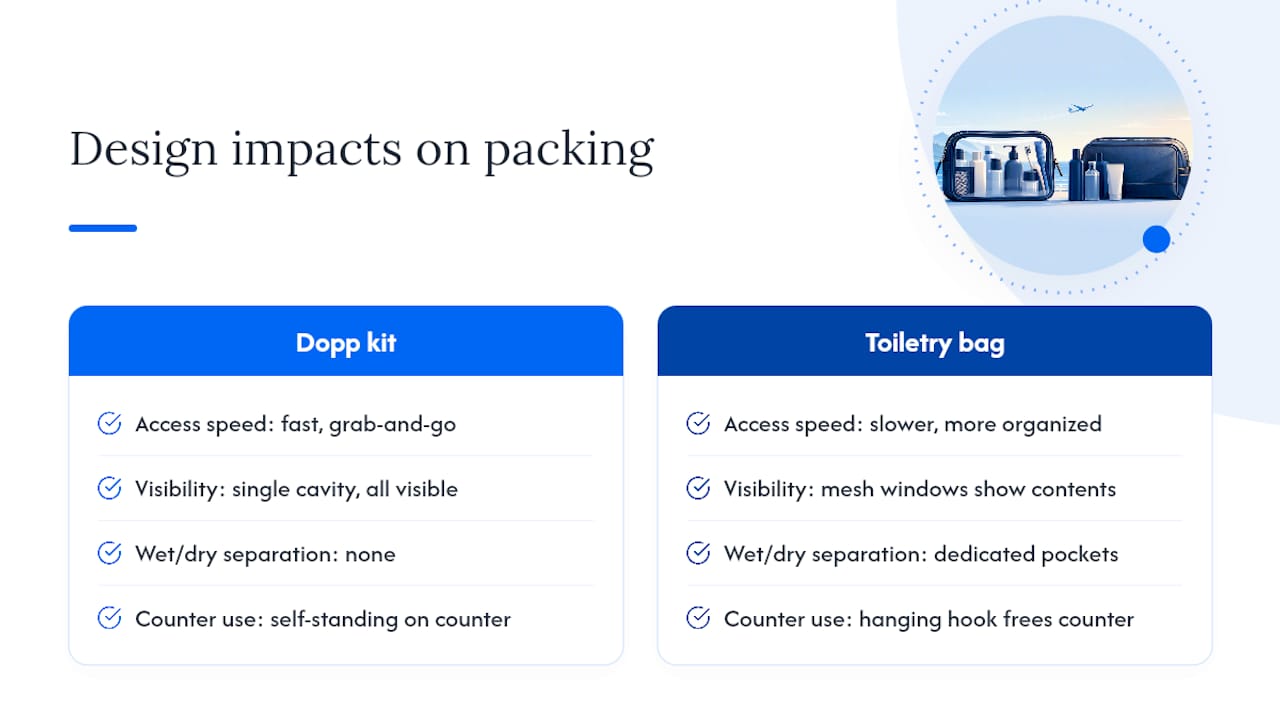
A single-compartment Dopp kit is built for speed. You open it, everything is visible in one cavity, and you can grab your toothbrush without digging. That simplicity is also its weak point: shampoo next to your phone charger is a bad idea, and there’s nowhere to separate a wet washcloth from a dry razor. Self-standing shapes make these easy to set on a counter, which is part of why the style has stuck around for a century.
A multi-compartment toiletry bag trades some of that grab-and-go speed for organization. Dedicated pockets for wet and dry items, mesh windows so you can see what’s inside without unpacking, and a hanging hook that frees up counter space in cramped bathrooms all address a different problem: keeping ten small items from becoming eight lost items. Modern toiletry bag designs increasingly favor exactly this kind of compartmentalization over the boxy single-cavity approach.
Interior color is an underrated detail here. A black lining hides a lot, including the travel-size deodorant you’re searching for at 4:45 a.m. Manufacturers who study usability closely point to bright interiors and elastic loops as small changes that cut down on lost items and slow fumbling, regardless of what the bag is called on the box.
When to Choose Each Style for Your Trip
Match the bag to the trip, not the label. A few scenarios make the decision almost automatic:
- A weekend trip or a gift. A compact Dopp kit works well here. You’re packing light, you won’t be sharing the bathroom counter with anyone, and the classic look makes it a solid present for a graduation or a birthday.
- A week-long trip, family travel, or a shared bathroom. A structured, multi-compartment toiletry bag wins. Four toothbrushes and three kinds of sunscreen need separation, and a hook that keeps the whole thing off a hotel counter (or a cruise cabin sink barely big enough for one razor) saves real friction.
- Camping, hiking, or anywhere wet gear is involved. Favor a synthetic-lined hanging bag over leather. A damp washcloth or a leaking bottle of bug spray is far less forgiving on leather than on a wipeable liner, and a hanging hook matters more when there’s no counter at all, just a tent vestibule or a campground sink.
- Business travel with tight carry-on space. A slim toiletry bag with clear wet/dry zones lets you clear airport security without unpacking everything, since TSA agents can see your liquids bag at a glance instead of asking you to dig through a single deep pocket.
The SPFDD Checklist for Picking a Toiletry Bag
Skip the semantic debate at checkout and run any candidate bag through five practical filters: Size, Portability, Functionality, Durability, and Design, or SPFDD.
- Size: A small bag (roughly 6 to 8 inches) suits a weekend; medium (9 to 11 inches) covers a week for one traveler; large (12 inches or more) handles family trips or longer stays. Keep your quart-sized liquids bag separate for airport security regardless of which toiletry bag you check.
- Portability: Look for a sturdy top handle or a hanging hook that actually holds weight without pulling loose after a few uses.
- Functionality: Count the compartments and check whether wet and dry items are actually separated, not just visually divided.
- Durability: Test the zipper pull with two fingers, and check the seams where the lining meets the exterior fabric, which is where cheap bags fail first.
- Design: Color and finish affect perceived value more than most buyers expect. A matte, structured exterior tends to read as more premium than shiny nylon, even at a similar price point.
Editorial testers who evaluate dozens of bags for a living consistently flag hanging capability, waterproof liners, and reliable zippers as the features that separate a good bag from a frustrating one, which lines up closely with the SPFDD approach.
Pro Tip: Buy the bag with the lightest-colored interior you can find. A cream or light gray lining makes every small item visible at a glance, which matters more than any exterior finish once you’re actually using the bag.
Leather vs Synthetic: Materials and Care Tips
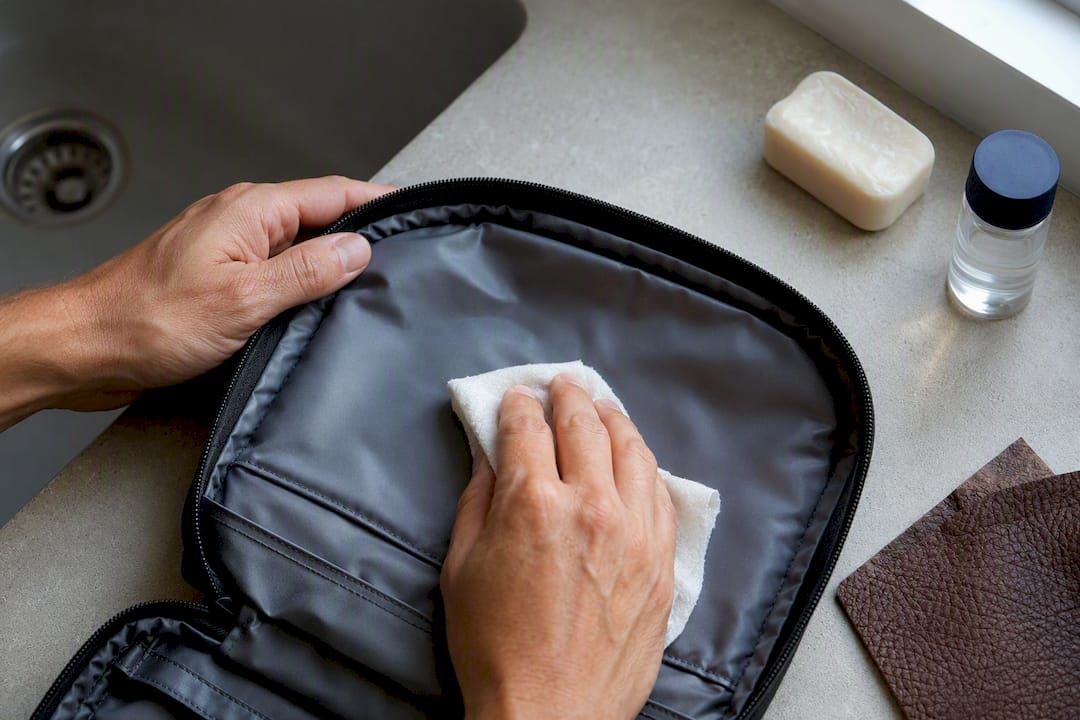
Leather ages well and looks the part, but it punishes spills. A leaked bottle of sunscreen or a wet toothbrush left too long can stain or warp a leather interior, and leather linings are harder to clean and more prone to lingering odor or mold than synthetic ones. Synthetic liners, usually nylon or TPU, wipe clean with a damp cloth in under a minute and shrug off the occasional leak without lasting damage.
Cleaning either style follows the same basic steps: wipe the interior with a damp cloth and mild soap, let it air-dry completely before repacking, and treat any leak immediately rather than letting liquid sit against fabric or leather overnight. Store your bag empty and open, not zipped shut in a closet, since trapped moisture is the main cause of the musty smell that ruins an otherwise good bag.
Why Stoiq Built a 3-Compartment Toiletry Bag
Every organizational problem described above, lost small items, wet gear touching dry gear, dark linings that hide what you need, comes down to the same root cause: bags designed around a shape instead of around how people actually pack. Stoiq’s approach to travel gear, built around packing efficiency across its whole product line, applies that same thinking to toiletries: separate the compartments first, then let the shape follow.
A three-compartment layout isn’t a gimmick. It’s a direct answer to the wet/dry separation problem this article keeps circling back to.
— Hugh
A Toiletry Bag Built Around These Exact Trade-Offs
The Stoiq Toiletry Bag in matte black takes the multi-compartment approach outlined above and builds it into a single, travel-ready case: three separate compartments for wet and dry separation, an easy-clean liner instead of leather, and a compact profile that fits into a carry-on without eating your packing cube space.
It suits the family traveler juggling four sets of toiletries, the frequent flyer who wants zippers that survive a hundred trips, and anyone who read the SPFDD checklist above and wants a bag that already checks every box. If you’re also fighting for carry-on space elsewhere in your luggage, pair it with the Stoiq Carry-On Solution 20L to compress clothing and free up room for the toiletry bag itself. Either way, start with the toiletry bag product page to see sizing and current availability.
Primary Sources and Further Reading
- Have you ever heard of a Dopp Kit? — Tusting: origin of the term and its American usage.
- Toiletry bag — Wikipedia: overview of design variation and common synonyms.
- The 7 Best Toiletry Bags of 2026 | Wirecutter: editorial testing standards for hanging bags, liners, and zippers.
Sources
- Have you ever heard of a Dopp Kit? — Tusting
- Toiletry bag — Wikipedia
- The 7 Best Toiletry Bags of 2026 | Wirecutter
FAQ
Is a Dopp Kit the Same as a Toiletry Bag?
Yes, functionally. Both hold the same items and serve the same purpose; “Dopp kit” is simply the older, primarily American name for what most of the world now calls a toiletry bag.
What Do Americans Call a Toiletry Bag?
Americans use “toiletry bag” and “Dopp kit” interchangeably, with “Dopp kit” carrying a slightly more classic, heritage connotation, especially for leather styles marketed toward men.
Why Do They Call It a Dopp Bag?
The name comes from Charles Doppelt, whose 1919 toiletry case design became widely used, including in later military contracts, which cemented the term in American English.
What Is the Difference Between a Cosmetic Case and a Dopp Kit?
A cosmetic case is typically marketed toward makeup and skincare storage with smaller pockets for compacts and brushes, while a Dopp kit or toiletry bag is built around general grooming items like razors, toothbrushes, and travel bottles. The line between them blurs constantly, and a bag like the Stoiq 3-compartment toiletry bag is designed to handle both categories at once.
