


Avoid 3.4 oz Confiscation: Pack TSA Carry-On Liquids Right with Stoiq
Your carry-on liquids must follow the TSA 3-1-1 rule: each container holds small travel-approved amounts of liquid or less, all containers fit inside one quart-sized clear resealable bag, and you get one bag per passenger. Medications and baby formula or breast milk are exempt from that limit, but you have to declare them at the checkpoint. Beyond that, the TSA officer in front of you has the final call.
TL;DR:
- Over 20,000 travelers have successfully used vacuum compression bags to triple their packing capacity, helping them better allocate liquids between carry-on and checked baggage.
- Medications, breast milk, and duty-free liquids are exempt from the 3-1-1 limit but must be declared before screening, with oversize or partially thawed liquids still subject to rejection.
- All liquids and aerosols, including items like honey or mascara, are subject to size and container restrictions, regardless of how full the containers are.
- Packing liquids in travel-size containers, switching to solid alternatives, and pre-sorting them into a transparent organizer reduces delays and improves security screening speed.
- Many travelers fail to check container size and assume near-empty bottles are compliant, risking confiscation, especially if they become complacent after repeated airport visits.
Table of Contents
- One-Minute Packing Checklist: Carry-On vs. Checked
- What Actually Counts as a “Liquid” at TSA Screening
- When You Can Bring More Than 3.4 Ounces
- Packing Techniques That Avoid Alarms, Leaks, and Confiscation
- How Stoiq Helps You Pack Smarter Around the 3-1-1 Rule
- What to Expect at the Security Checkpoint
- The Bottom Line on Carry-On Liquids
- Why the 3-1-1 Rule Trips Up Experienced Travelers More Than Beginners
- Sources
One-Minute Packing Checklist: Carry-On vs. Checked
Before you zip your bag shut, run through this fast. Most delays at security happen because a traveler didn’t sort liquids ahead of time, not because the rules are complicated.
Follow 3-1-1 and go in the quart bag:
- Toothpaste, shampoo, conditioner, and lotion in travel-size containers
- Sunscreen and hand sanitizer in travel-size containers
- Aerosols like dry shampoo or spray deodorant in travel-size containers
Declare at the checkpoint, don’t bag them:
- Prescription and over-the-counter medications
- Breast milk, formula, and juice for infants or young children
Pack in checked baggage instead:
- Full-size shampoo, lotion, or shaving cream bottles
- Large contact lens solution bottles you won’t need mid-flight
- Alcohol over 140 proof, or wine and liquor bottles that won’t fit the carry-on limit
Pro Tip: Keep your quart bag in an outer pocket, not buried under clothes. You’ll pull it out faster, and you’re less likely to get pulled aside for a bag search.
What Actually Counts as a “Liquid” at TSA Screening
Liquids, gels, aerosols, creams, and pastes all fall under the same 3-1-1 bucket, and that catches more items than most travelers expect. Toothpaste, mascara, peanut butter, and yes, that jar of honey you picked up on vacation, are all liquids in TSA’s eyes. Solid deodorant, dry shampoo powder, and bar soap are not, so they skip the quart bag entirely.
Here’s the detail that trips people up most: the TSA enforces container size, not how full the container actually is. A 12-ounce shampoo bottle with one squeeze left inside is still a 12-ounce bottle, and it still gets pulled at the checkpoint. Travelers routinely assume “almost empty” equals “compliant.” It doesn’t.
A few categories get special handling:
- Powders over a certain volume may require separate screening, even though they’re not liquids.
- Frozen items that are frozen completely solid at screening time are generally treated differently than liquids, but they can’t be partially thawed.
- Live fish in water are allowed with some airline-specific conditions, oddly enough, but the water still counts toward screening review.
The rule exists for a reason grounded in security screening around volatile-substance density in small containers, which is also why the quart bag itself matters. It’s not a suggestion. It physically caps how much total liquid volume you can carry, which is the whole point.
When You Can Bring More Than 3.4 Ounces
A handful of situations let you go over the standard limit, but every one of them comes with a catch.
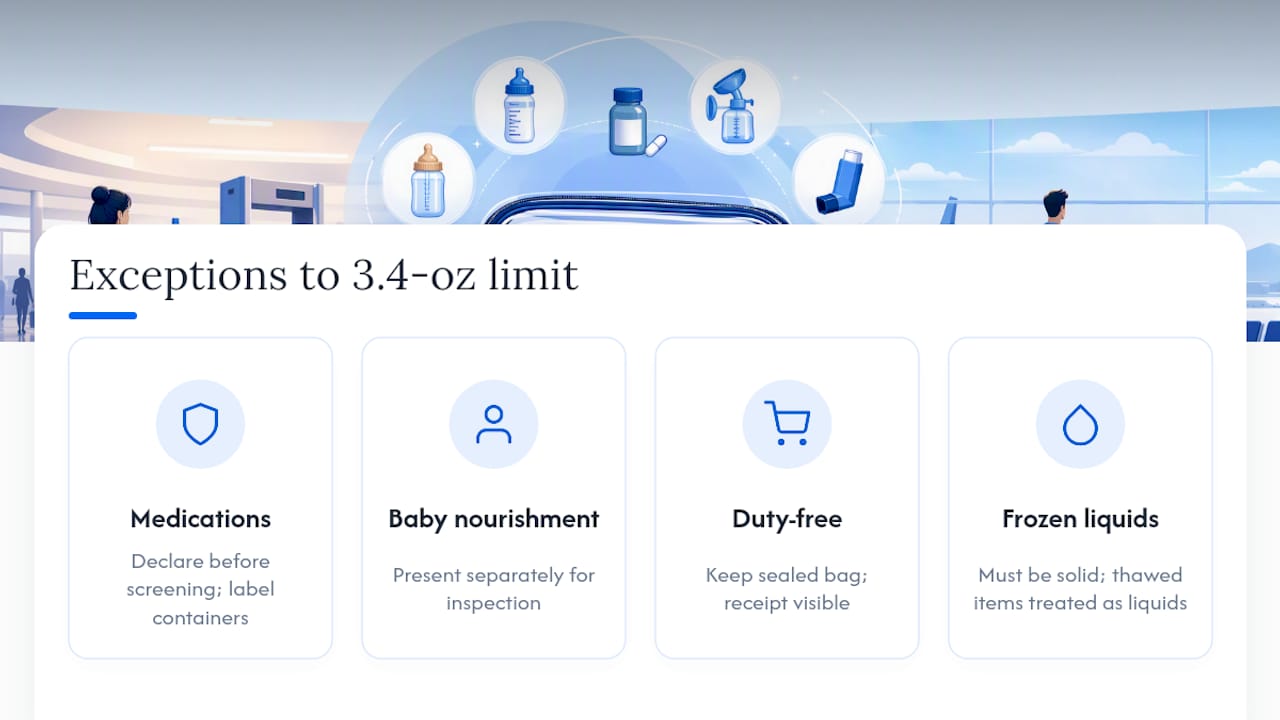
Medications and medical liquids. Medically necessary liquids are exempt from the 3-1-1 limit, but you have to tell the officer before screening starts. Label the containers clearly. Some items, like certain contact lens solutions, can still trigger an alarm during testing and get denied even after you’ve declared them, so the practical move is to pack only a day’s supply in your carry-on and put the rest in checked baggage.
Baby and toddler nourishment. Formula, breast milk, and juice for children traveling with you are exempt too from size limits. Present them separately from your quart bag rather than mixing them in, and expect the officer to test or inspect them.
Duty-free purchases. Liquids bought past security can exceed 3.4 ounces if they’re sealed in a secure, tamper-evident bag with the receipt visible, typically within 48 hours of purchase for connecting flights. Even then, they still go through screening and can be denied if they alarm.
Frozen liquids. Ice packs and frozen liquids are fine if solid all the way through. Once they start to thaw, they’re treated as liquids under the standard limit.
Packing Techniques That Avoid Alarms, Leaks, and Confiscation
Good packing isn’t about outsmarting the screener. It’s about making your bag boring to inspect, which is exactly what gets you through faster.
- Buy actual travel-size containers, 3.4 oz or under, rather than eyeballing a bigger bottle. Leak-proof caps matter more than you’d think at altitude.
- Switch to solids where you can. Solid shampoo bars, toothpaste tablets, and stick sunscreen skip the liquids rule completely and free up space in your quart bag for what actually needs to be liquid.
- Double-bag anything fragile. A snapped cap on a glass perfume bottle ruins more than your toiletry kit.
- Keep meds and baby items in an easy-access pocket, separate from your quart bag, so you’re not digging through your whole carry-on while a line builds behind you.
- Save receipts for duty-free items and keep them with the sealed bag, not in your wallet.
- Move anything that won’t fit the limit to checked baggage, wrapped in clothing or a sealed pouch to catch leaks in transit.
Airport travel guides consistently point out that travelers who pre-sort liquids into a dedicated, transparent organizer move through screening faster, since officers can see everything without opening multiple compartments.
How Stoiq Helps You Pack Smarter Around the 3-1-1 Rule
Vacuum compression bags don’t change a single TSA rule, and no product does. What they change is how much room you have left to work with, which matters more than people realize when they’re staring at a half-packed carry-on the night before a flight.
Stoiq’s vacuum compression bags use a built-in, rechargeable USB-C pump, so you’re not hunting for a separate device to squeeze the air out. That integrated design is the core difference from most compression bags on the market, and it’s part of why over 20,000 travelers have used Stoiq products to pack 2 to 3 times more clothing into the same carry-on space.
Here’s where that actually helps with liquids: compressing your clothing frees up carry-on space so you can move full-size toiletries to checked baggage instead of cramming everything into one quart bag. A 3-compartment toiletry organizer keeps your travel-size liquids visible and grouped, which speeds up the moment an officer asks you to present them.
What compression bags don’t do:
- Exempt any liquid from the 3.4 oz limit
- Let you skip the quart bag requirement
- Change how TSA screens medications or baby items
Think of it as freeing up the suitcase, not bending the rule.
What to Expect at the Security Checkpoint
Pull your quart bag out before you reach the bin, not after the officer asks. Set it flat, along with any declared medications or baby items, separate from the rest of your carry-on.
- Declare exempt items out loud. Say it plainly: “I have medication” or “I have breast milk to declare.” Officers expect this and it moves faster than letting them find it.
- Expect testing on suspicious liquids. Some medically necessary items or duty-free bottles get swabbed or run through additional screening, even after you’ve declared them.
- Know that some airports let you keep the bag inside your carry-on. Newer CT scanners at select larger airports allow this in some cases, but the 3-1-1 limits themselves don’t change either way.
- Understand officer discretion is final. If something alarms during screening, the TSA officer decides whether it’s cleared, retested, or denied, regardless of what the general rule allows.
The Bottom Line on Carry-On Liquids
The 3-1-1 rule isn’t going anywhere in 2026: 3.4 ounces per container, one quart bag, one bag per traveler. Before you leave the house, check three things: every bottle is under the limit, they all fit in one bag, and anything exempt (meds, baby items) is separated and ready to declare.
- Move oversize liquids to checked baggage rather than risk confiscation
- Label medications clearly, especially anything that could alarm during screening
- Keep duty-free purchases sealed with the receipt visible
Travelers who sort liquids the night before consistently report fewer checkpoint delays than those who pack at the gate.
Why the 3-1-1 Rule Trips Up Experienced Travelers More Than Beginners
The people who get stopped at security aren’t usually first-time flyers. They’re the frequent travelers who’ve flown enough times to get complacent, and complacency is exactly what the “almost empty bottle” mistake feeds on. You know the rule exists, so you assume a nearly-drained lotion bottle is fine. It isn’t. TSA checks the bottle printed on the label, not what’s sloshing around inside.
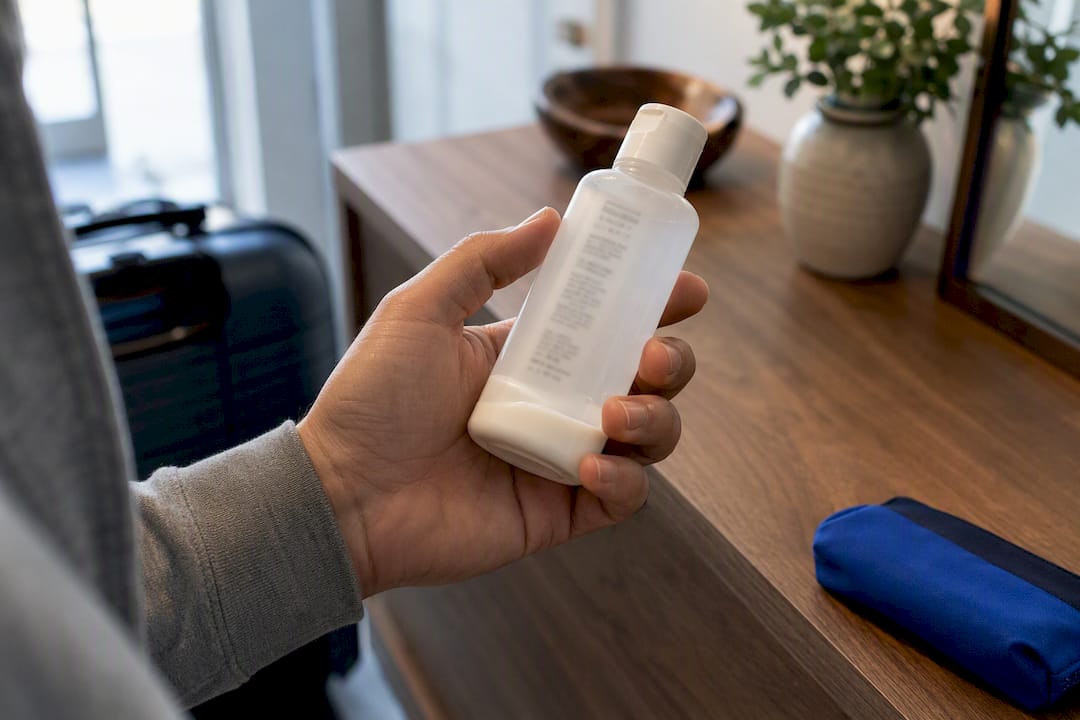
The bigger gap I see in most advice on this topic is that it treats packing and compliance as separate problems. They’re not. A traveler who’s fighting to zip a carry-on shut is far more likely to grab whatever bottle is handy instead of the travel-size one sitting in a drawer at home. Give yourself more room in the bag, and the compliant choice becomes the easy choice.
Prioritize this first: sort liquids before you touch clothes. Decide what’s exempt, what’s under 3.4 ounces, and what’s getting checked. Everything else, including how you compress the rest of your packing, gets easier once that decision is made.
— Hugh
Sources
- Liquids, aerosols, and gels rule | Transportation Security Administration
- Frequently asked questions | Transportation Security Administration
- TSA liquid limits: How much liquid can you bring on a plane? | AirHelp
