



Travelers: Do Vacuum Bags Cut Luggage Weight? Air Math and When Stoiq Helps
Vacuum bags shrink the space your clothes take up, but they do almost nothing to their weight. The air you suck out weighs only a few grams per liter, while the bag and pump you add back can weigh several ounces. If your suitcase won’t zip shut, compression solves that. If your suitcase is over the airline’s weight limit, compression will not save you.
TL;DR:
- Vacuum bags mainly reduce volume, but the weight of the bag and pump often cancels out any weight savings from removing air.
- Removing air in a large checked bag yields only a few grams of weight reduction, which is insignificant compared to the hardware weight.
- Built-in or rechargeable pump systems offer convenience but add 150 to over 300 grams of hardware weight, negating any net weight loss.
- Compression is most effective for volume issues, such as fitting bulky clothing into a closed suitcase, not reducing overall weight.
- Weighing your gear before and after compression confirms whether the method addresses your specific problem—space or weight.
Table of Contents
- Vacuum Bags Weight vs. Volume: The Physics Traveler Guides Skip
- Do the Bags and Pumps Themselves Add Weight?
- When Compression Actually Helps You Dodge Baggage Fees
- Roll Bags, Manual Pumps, or Built-In Systems: Picking Your Setup
- What Stoiq Users Actually Notice When They Compress
- A Simple Packing Routine That Won’t Backfire
- A Travel Pro’s Quick Take
- Pack Smarter With Stoiq’s Compression Lineup
- Sources
- FAQ
Vacuum Bags Weight vs. Volume: The Physics Traveler Guides Skip
Here’s the mix-up that trips up almost every traveler shopping for compression bags: weight and volume are not the same measurement, and squeezing one doesn’t touch the other. Volume is how much space your sweater takes up in your suitcase. Weight is what a luggage scale reads when it’s dangling from the handle at the check-in counter. Vacuum bags attack volume by pushing out the air trapped between fibers. They leave the actual mass of your clothes, shoes, and toiletries untouched, because cotton, denim, and rubber don’t get lighter just because they’re flatter.
The confusion comes from a reasonable but wrong assumption: air feels weightless, so removing a lot of it should shave off real pounds. It doesn’t, because air is far lighter than most people guess. At sea level, air has a density of roughly 1.2 kilograms per cubic meter, which works out to about 1.2 grams per liter.
Stat check: Pack a large vacuum bag that holds air before you compress it. Removing all of that air only sheds a very small amount of weight, roughly comparable to light, everyday small items.
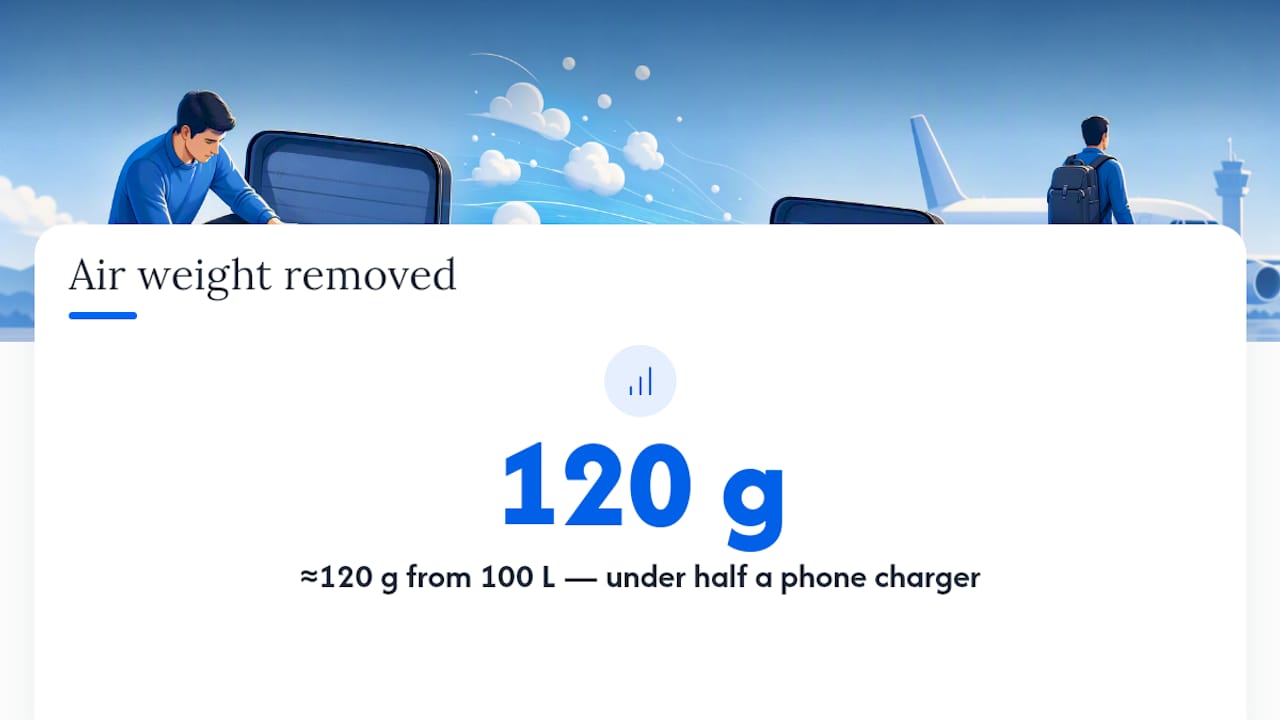
Run the math on a full checked bag stuffed with winter coats and blankets, and you might squeeze out 100 liters of trapped air across several bags. That’s still only around 120 grams, less than half the weight of a phone charger. For precision nerds, the CIPM-2007 equation from NIST formalizes how moist air density gets calculated, and it confirms the same conclusion: air’s contribution to your total luggage weight is a rounding error, not a strategy.
Do the Bags and Pumps Themselves Add Weight?
This is where a lot of packing advice quietly skips over the inconvenient part. If removing air only saves grams, then the bag, valve, and pump you’re using need to weigh less than that to produce any real net savings. Often, they don’t.
Typical vacuum-style storage bags run anywhere from 50 to 150 grams each, depending on plastic thickness and valve design. A manual hand pump adds another 100 to 250 grams. Built-in electric pump systems, prized for convenience, tend to weigh more since they house a motor and a rechargeable battery, often pushing total hardware weight past 300 grams once you count the bag itself.
Do the arithmetic on the earlier example: you saved 48 grams by removing air from one bag, but the bag and its valve alone might weigh 80 grams. Add a pump, and you’ve made your suitcase heavier, not lighter, even though it now looks dramatically flatter.
That’s not a knock against compression bags. It’s a reminder that flatter doesn’t automatically mean lighter, and travelers chasing airline weight limits need to check both sides of the ledger.
- Lightweight roll-style compression sacks: 40 to 100 grams
- Standard zip-and-valve vacuum bags: 50 to 150 grams
- Manual hand pumps: 100 to 250 grams
- Electric or built-in rechargeable pumps: 150 to 300+ grams
Stat check: A traveler compressing four sweaters into one vacuum bag saves a very small amount of air weight, which is offset by the weight of the bag and valve. This results in little or no net weight savings, even though the suitcase becomes easier to close.
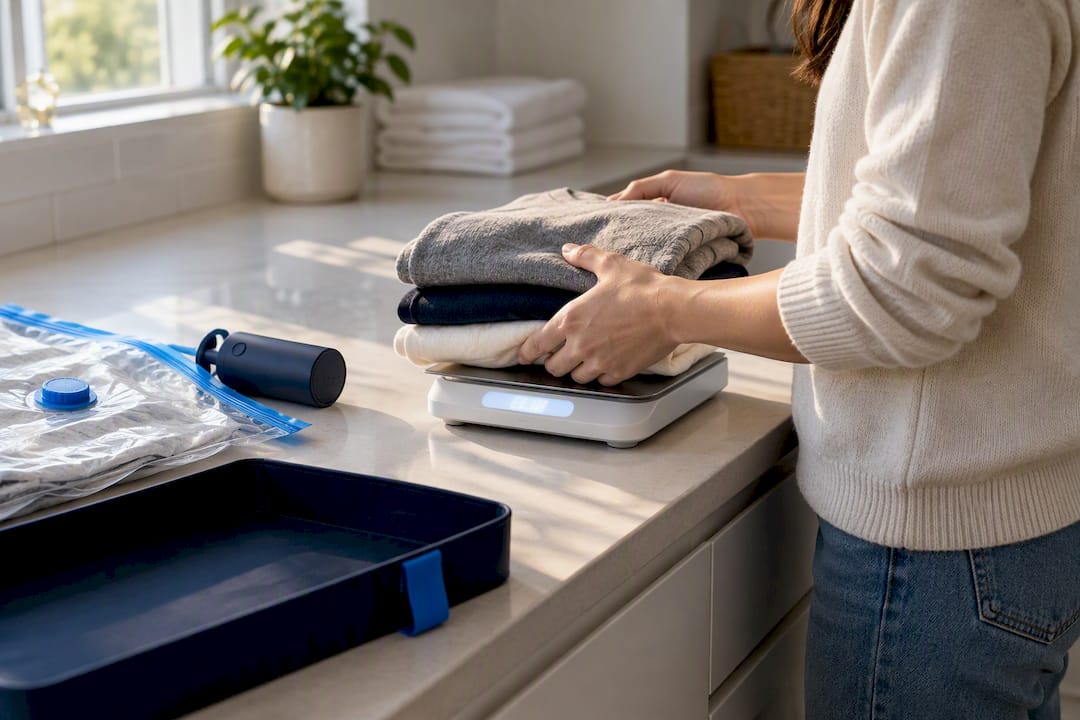
Before your next trip, weigh your empty bag, your pump, and your clothing separately on a kitchen or luggage scale. That fifteen-second test tells you the real net effect for your exact gear, instead of relying on marketing copy.
When Compression Actually Helps You Dodge Baggage Fees
Airlines enforce two completely separate limits, and knowing which one you’re up against changes everything about whether vacuum bags help. A checked bag usually maxes out around 50 pounds domestically, and that’s a strict weight cap. Carry-ons face a size cap, often a linear dimension limit, which is really a volume problem in disguise. Compression bags are built to solve volume problems. They cannot solve weight problems, because as covered above, they barely touch mass.
Here’s how that plays out in real situations:
- Your suitcase won’t zip closed because a bulky parka and two sweaters are fighting the lid. Compression flattens them, the zipper closes, and you’re fine. This is a volume problem, and vacuum bags are the right tool.
- Your suitcase already reads 52 pounds on the airport scale. Compressing the clothes inside won’t bring that number down in any meaningful way. Your real fixes here are removing a heavy item, shifting something into your personal item bag, or paying the overweight fee upfront online where it’s often cheaper.
- You’re on a multi-stop trip repacking every two or three days. Compression still helps with volume between destinations, but you’ll be inflating and deflating the bag repeatedly, so ease of repacking matters as much as compression ratio.
- You’re a business traveler with one garment bag and tight overhead-bin space. Compression sacks for shirts and layers solve the space crunch without adding much hardware weight, since business travel kits tend to be lighter to begin with.
Pro Tip: Weigh your bag at home with a standard luggage scale before you leave, not just once packed but again after compressing. If the number barely moves, you’ve confirmed you’re dealing with a volume problem, not a weight problem, and compression was the right call.
Roll Bags, Manual Pumps, or Built-In Systems: Picking Your Setup
Every compression method trades some convenience for some weight, and the “best” one depends entirely on how you travel, not on which product has the flashiest marketing.
- Roll-type compression sacks skip air valves and pumps entirely. You roll the bag to push air out through a one-way seal. They’re the lightest option, easy to repack on the fly, and forgiving for multi-stop itineraries where you’re opening bags every couple of days. Compression ratio is moderate, not extreme.
- Manual hand-pump vacuum bags use a small external pump to suck out significantly more air than rolling alone, giving you a tighter, flatter result. The tradeoff: you need the pump with you to repack, which means carrying an extra piece of gear and remembering where you put it.
- Built-in or electric pump systems, including Stoiq’s rechargeable pump design, integrate the pump directly into the bag or backpack. You get the highest compression ratio and never lose a separate pump, but you’re carrying that hardware weight for the entire trip and need to keep it charged.
Travel testing on compression gear generally points toward roll-type bags for travelers who repack often, reserving vacuum-style bags for situations like a single long-stay trip where you pack once and don’t touch the bag again until you’re home. If you’re deciding between compression bags and packing cubes for your specific trip style, it’s worth comparing how each approach handles space differently before you buy either one.
What Stoiq Users Actually Notice When They Compress
Stoiq builds its bags around a USB-C rechargeable pump attached directly to the bag, so there’s no separate hand pump to lose in a hotel drawer. The company’s own claim is that this setup lets travelers pack two to three times more into a carry-on than they would folding clothes the traditional way, a figure worth checking against the specific product pages rather than taking on faith.
Built-in pumps make the most sense for single-destination trips: pack once at home, compress, and don’t reopen the bag until you land. They make less sense for someone hopping between four cities in ten days, since you’ll be recharging and repacking constantly.
Before buying any compression product, run it through this checklist:
- Pump weight: does the listed weight include the pump, or just the bag?
- Battery life: how many compression cycles per charge, and does that match your trip length?
- Seal reliability: is the valve a one-way check valve, or does it need manual closing every time?
- Material thickness: thicker material resists punctures better but adds a few extra grams.
Pro Tip: Ask any product listing for the bag’s tare weight in grams, not just its capacity in liters. Capacity tells you what it holds; tare weight tells you what you’re carrying.
A Simple Packing Routine That Won’t Backfire
Getting the benefit of compression without an ugly surprise at check-in comes down to a short routine, done before you ever leave the house.
- Weigh your empty suitcase, then weigh your compression bag and pump separately.
- Pack normally, weigh the closed suitcase, then compress and weigh it again.
- Compare the two numbers. If the difference is small or negative, you’re solving a space problem, not a weight problem.
- Distribute heavier items low and centered, since a compressed load can shift more than folded clothes.
- Avoid crushing down jackets or anything down-filled for long periods, since it can flatten insulation permanently.
| Step | What to check | Why it matters |
|---|---|---|
| Home scale test | Bag + pump + clothes weight before and after | Confirms your real net change |
| Repacking plan | Pump access for multi-stop trips | Avoids getting stuck mid-trip |
| Gate check | Keep valuables and medication unpacked | Avoids digging through a vacuum-sealed bag at security |
A Travel Pro’s Quick Take
For a single long trip, a built-in pump bag earns its weight in convenience. For anything with more than one stop, I’d default to a roll-type sack every time, since you’ll be repacking without hunting for a pump. That’s the split that actually holds up.
— Hugh
Pack Smarter With Stoiq’s Compression Lineup
Once you’ve confirmed compression solves your specific problem, closing the suitcase and freeing up carry-on room, Stoiq gives you a built-in pump instead of a separate device to pack, charge, and lose in a side pocket. That’s the practical difference between Stoiq and a plain vacuum bag: you get the compression without an extra gadget riding along in your luggage.

Before buying, check the specs on the Stoiq Carry-On Solution, including its listed tare weight and battery life, so you know exactly what you’re adding to your bag. The Stoiq Carry-On Solution collection covers sizes from 20 to 25 liters starting around $100 to $120, and the Stoiq Compression Backpack runs $160 for travelers who want the pump built into a wearable bag rather than a packing insert. If you’re set on a single-destination trip where repacking isn’t a concern, browse the collection and pick the size that matches your carry-on dimensions.
Sources
- Air Properties Definitions — NASA Glenn Research Center
- Vacuum compression bags travel testing — Travel + Leisure (2026)
- CIPM-2007 equation for density of moist air — NIST
FAQ
Do Vacuum Travel Bags Add Weight?
Often, yes. The bag material, valve, and any pump typically weigh more than the few grams of air you remove, so your packed item can end up slightly heavier on a scale, not lighter.
Do Vacuum Storage Bags Reduce Weight?
They reduce volume, not weight. Air removed from a vacuum bag weighs about 1.2 grams per liter, which means even a large bag only sheds a few dozen grams, far less than most people expect.
How Much Does an Average Vacuum Bag Weigh?
Standard vacuum storage bags run roughly 50 to 150 grams empty, while manual pumps add 100 to 250 grams and built-in electric pump systems can push total hardware weight past 300 grams.
Are Things Heavier When Vacuum Sealed?
The clothing itself weighs the same either way, since compressing air out doesn’t change the mass of fabric or gear. Once you add the bag and pump weight back in, the total packed item is sometimes heavier than it was loose.
Does Stoiq’s Pump Add a Lot of Extra Weight?
Stoiq lists tare weight and specs directly on its product pages, so you can check the exact figure before buying rather than guessing. Current prices for the Carry-On Solution and Compression Backpack are available on the collection page.
