



Travelers: Pack Wrinkle-Free by Matching Method to Fabric
Match your packing method to the fabric, not the other way around: roll knits and casual pieces, bundle-wrap or fold structured wovens with tissue paper between layers, and load your suitcase heavy-to-light from base to top. Carry a few small tools (tissue or dry-cleaning bags, packing cubes, a garment folder, a travel-size spray bottle) and unpack shortly after arrival so gravity and steam do the rest of the work for you.
TL;DR:
- Using a hybrid packing approach tailored to each fabric type helps prevent wrinkles, with knits and synthetics best suited for rolling and woven fabrics for folding or bundle wrapping.
- Layering clothes in three levels—heavy items at the bottom, casual rolls in the middle, and delicate or structured garments on top—reduces the risk of creases during travel.
- Natural fibers like linen, cotton, and silk require delicate handling such as bundle wrapping or tissue-interleaved folding, as they crease easily and do not recover quickly from compression.
- Wrinkle-release methods like steaming in the shower or using a travel steamer effectively relax fiber tension without the need for an iron, saving time and space in packing.
- Combining compression bags with traditional packing cubes allows maximum space savings for synthetic and stretchy fabrics while protecting sensitive materials from crushing.
Table of Contents
- What Is the Best Wrinkle Free Packing Method?
- Which Fabrics Wrinkle the Least?
- How Should You Layer Your Suitcase to Avoid Creases?
- How Do You Get Wrinkles Out of Clothes Without an Iron?
- What Should Be on Your Pack-Ready Checklist?
- Balancing Space and Presentation on Real Trips
- Another Option Worth Considering: Compression Bags
- Sources
- FAQ
What Is the Best Wrinkle Free Packing Method?
There isn’t one single technique that beats every other. The reliable approach is a hybrid one that pairs the right method with the right fabric, and knowing which tool to reach for is most of the battle. Here’s how the four main methods work and when each one earns its spot in your suitcase.
Rolling
Rolling is your default for knits, T-shirts, athletic wear, and anything casual. Lay the garment flat, smooth out major wrinkles with your hand, and roll from the hem toward the collar, keeping the roll snug but not stretched.
- Fold sleeves in first if it’s a shirt or jacket.
- Roll tightly, seam-side facing inward so the seam doesn’t press a line into the fabric.
- Slide finished rolls into a packing cube standing on end, like books on a shelf, so you can see and grab each one without disturbing the rest.
Folding with tissue or dry-cleaning bags
For dress shirts, trousers, and anything structured, folding beats rolling, but only if you interrupt the fold lines. Slide a sheet of tissue paper or a plastic dry-cleaning bag between every major fold. The slick surface lets fabric layers slide against each other instead of gripping, which is what stops a soft crease from becoming a permanent set line. Fold trousers along their existing seam crease, never a fresh one, and fold shirts in thirds rather than quarters to reduce the total number of pressure points.
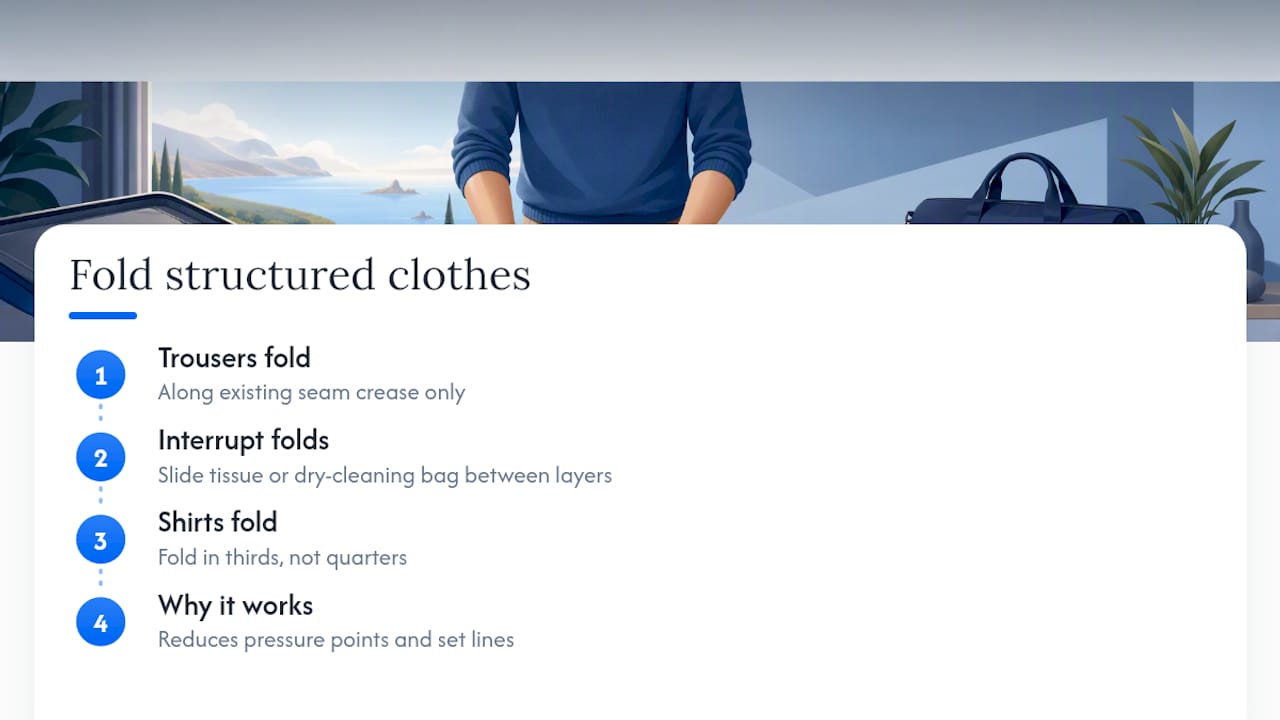
Bundle wrapping for dress clothes
Bundle wrapping is the method most travelers have never tried and should. Start with a soft core, a rolled sweater or a stuffed packing cube works well, and wrap your structured garments (blazers, dress shirts, suit pants) around that core one layer at a time, the largest item first. Because the fabric curves around a soft center instead of folding flat, you get gentle bends instead of sharp creases. Avoid using a hard object like a shoe or a toiletry kit as your core; hard edges create the same pressure points you’re trying to avoid.
Garment folders and packing cubes
A garment folder (sometimes called a garment board) is built for one job: keeping a business shirt crease-free. Button the shirt, lay it face-down on the folder, fold the sides in around the board, then flip and fold once more. The rigid board prevents the multiple small creases that hand-folding creates.
Packing cubes are best treated as containers for rolls and small folded items, not as compression devices for delicate wovens. Squeezing a linen shirt into an overstuffed cube sets creases you can’t shake out with your hand. Use cubes to organize, not to compress anything you’d hang up at home.
- Rolling: knits, T-shirts, athletic wear, casual dresses.
- Folding with tissue: dress shirts, trousers, blouses.
- Bundle wrapping: blazers, suits, structured dresses.
- Garment folder: business shirts specifically.
Pro Tip: Keep one rolled sweater or a stuffed sock ball in your bag specifically as a bundle-wrap core. Reusing the same soft object every trip saves you from hunting for a stand-in at 6 a.m. on packing day.
Which Fabrics Wrinkle the Least?
Check the care tag before you decide how to pack a garment, because fiber content predicts wrinkling far better than how “nice” the fabric looks folded. Knits and synthetic blends forgive almost any packing mistake. Wovens and natural fibers punish sloppy folding within minutes of hitting your suitcase.
Fabrics that travel well:
- Merino wool: resists creasing and bounces back from compression.
- Nylon: durable, low-wrinkle, and tolerant of tight packing.
- Polyester blends with 2 to 5 percent spandex: the stretch fiber helps the fabric resist setting a crease in the first place.
Fabrics that need special handling:
- Linen: wrinkles almost on contact, so bundle-wrap it or accept a wrinkled-linen look as part of the fabric’s character.
- 100% cotton: prone to creasing, especially dress shirts. Use a garment folder or tissue-interleaved folding.
- Silk: delicate and prone to both wrinkling and snagging. Never compress it.
- Rayon: behaves like a natural fiber under stress and creases easily.
Polyester blends carrying a small percentage of spandex resist crease-setting in a way pure natural fibers simply can’t match. That stretch fiber is doing more work than most travelers realize. A quick shortcut: if a garment is knit (stretches when you tug it), roll it. If it’s woven (doesn’t stretch), fold it with tissue or bundle-wrap it. That one distinction settles most packing decisions before you even glance at the tag.
How Should You Layer Your Suitcase to Avoid Creases?
Suitcase layout matters as much as folding technique, because a perfectly rolled shirt still wrinkles if a heavy boot lands on top of it three hours into your flight. Build your suitcase in three layers.
- Base layer: shoes, toiletry bags, and any heavy or rigid items go on the bottom, closest to the wheels.
- Middle layer: rolled knits and casual items, packed inside cubes, fill the main body of the case.
- Top layer: bundle-wrapped garments and tissue-folded dress clothes sit on top, where they take the least pressure.
Fill gaps as you go. Stuff socks inside shoes, tuck a belt into a corner gap, and slide a phone charger into any empty pocket along the suitcase wall. Every unfilled gap is space where clothing can shift mid-flight, and shifting is what creates the random creases you didn’t cause by folding.
Hard-sided luggage holds its shape under pressure, which helps protect the top layer from getting crushed by an overhead bin neighbor’s bag. Soft-sided luggage flexes more, which is fine for casual trips but means your top layer needs a bit more protection, tissue paper or a dry-cleaning bag draped over the whole layer, when you’re carrying something you actually plan to wear that day.
Pro Tip: Pack your going-out outfit last, on top, inside its own dry-cleaning bag. That way you’re not digging past three layers of clothes to find it, and you’re not re-wrinkling everything else in the process.
How Do You Get Wrinkles Out of Clothes Without an Iron?
You don’t need an iron to arrive looking put-together. A handful of low-effort fixes handle almost every wrinkle a suitcase can create.
- Bathroom steam: hang the garment on the shower rod, run the hottest water your shower has for 10 to 20 minutes with the bathroom door closed, and let the steam relax the fibers. Keep the garment a few inches from direct water contact.
- Portable steamer: a compact travel steamer typically smooths a garment in 60 to 90 seconds, and it’s faster and more controlled than the shower trick. Avoid direct nozzle contact on silk or anything with beading or embellishment; hold the steamer a few inches away and let the vapor do the work.
- Wrinkle-release spray: mist lightly, smooth with your hands, and let the garment air-dry on a hanger.
- Dryer trick: toss the garment in a hotel dryer (if one’s available) with a damp washcloth for 10 minutes on low heat.
- Hang immediately: whichever fix you use, hang the garment right after so gravity keeps pulling the fabric straight while it’s still slightly warm or damp.
What Should Be on Your Pack-Ready Checklist?
A short kit and a short list of things to avoid cover almost every wrinkle problem before it starts.
Pack this:
- Tissue paper or dry-cleaning bags
- Packing cubes
- Garment folder or garment board
- Small spray bottle (for wrinkle-release spray or plain water)
- Rubber bands (used sparingly, only for rolled items that keep unrolling)
- Travel steamer (optional but useful for business trips)
Avoid this:
- Packing damp or slightly sweaty clothing. Moisture sets creases faster and can cause mildew smell.
- Overcompressing delicate wovens inside cubes or under heavy items.
- Leaving clothes packed for more than a day or two after you land.
- Folding along the same crease line every trip, which weakens the fabric there permanently.
| Common mistake | Why it causes wrinkles | Quick fix |
|---|---|---|
| Packing damp clothing | Moisture sets fiber memory under pressure | Air-dry fully before packing |
| Overcompressing delicates | Crushes fibers past their recovery point | Fold loosely; skip cubes for silk and linen |
| Long-term packed storage | Creases deepen the longer fabric sits folded | Unpack within two hours of arrival |
| Repeating the same fold line | Weakens and permanently marks the crease | Vary fold points or switch to rolling |
Balancing Space and Presentation on Real Trips
Not every trip calls for wrinkle-free precision, and pretending otherwise wastes energy you could spend enjoying the trip. A weekend camping trip or a beach vacation tolerates a wrinkled T-shirt just fine; a client dinner or a wedding does not. Match your packing effort to what the trip actually demands, not to some abstract standard of a perfectly pressed suitcase.
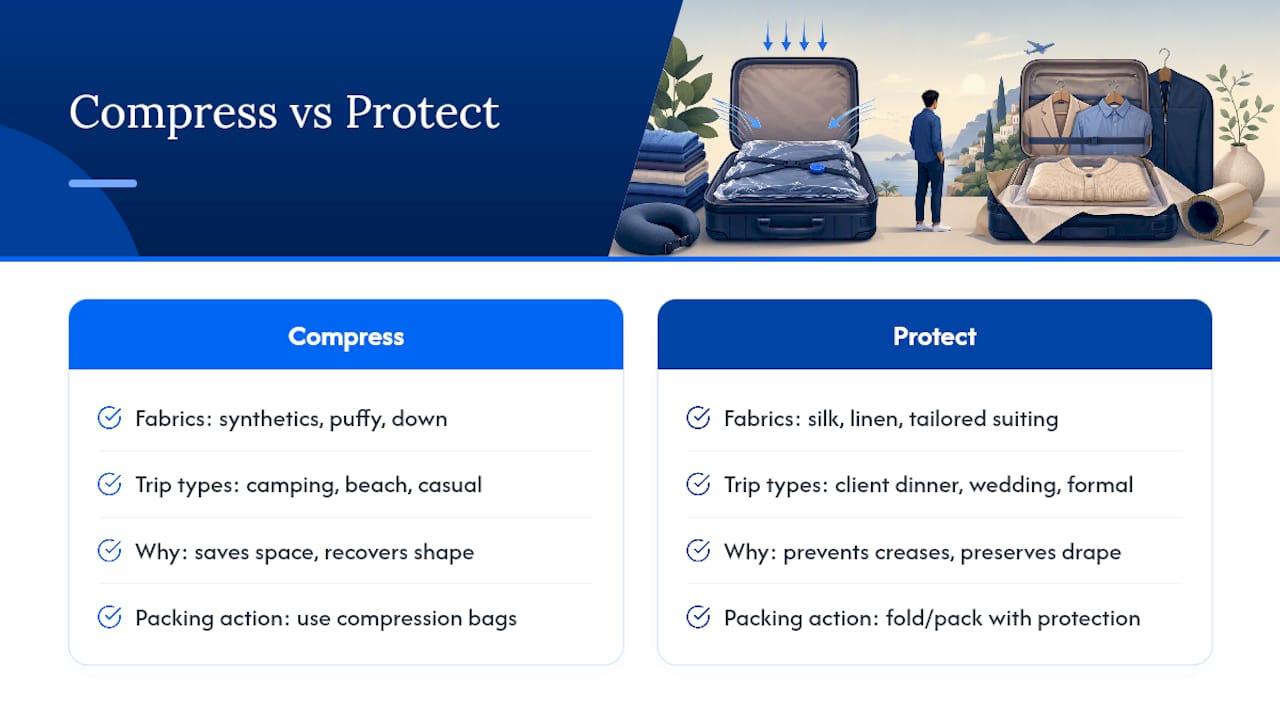
Compression deserves the same nuance. It’s a genuinely useful tool for synthetics, puffy layers, and down jackets, fabrics that recover their shape after being squeezed flat. It’s a poor tool for silk, linen, and tailored suiting, where the same squeeze sets a crease you’ll be steaming out for an hour. The travelers who get frustrated with compression bags are usually the ones using them on the wrong garment, not the ones using the wrong bag.
If there’s one habit worth building, it’s this: sort your clothes into “compress this” and “protect this” piles before you even open your suitcase. That five-minute sort saves more wrinkles than any folding trick ever will.
— Hugh
Another Option Worth Considering: Compression Bags
If you’ve read this far, you already know compression works beautifully on the right fabrics and badly on the wrong ones, which is exactly where a vacuum bag with a built-in pump earns its place in your packing routine. Some compression bags use an integrated, rechargeable pump instead of a separate hand pump or vacuum attachment, which means one less gadget to dig for at 6 a.m.
A core benefit of vacuum compression bags is that you can pack roughly two to three times more into the same carry-on space, which matters most for synthetics, knitwear, and bulky layers like fleece or a packable down jacket, the exact fabrics that bounce back from compression without setting a crease. Combine the two approaches rather than picking one. Compress your knits and casual layer inside a Stoiq Carry-On Solution 20L, then keep your dress shirts and anything linen or silk separate, folded with tissue paper or slid into a dry-cleaning bag on top where they won’t take any pressure. Travelers packing for longer trips often step up to the Stoiq Carry-On Solution 25L for the extra room a week or two away demands.
If you’re deciding between a compression bag and standard packing cubes for your next trip, compare how each actually performs on space before you buy either one.
Sources
- The 6 best travel-friendly fabrics for a wrinkle-free trip — Bosch Home
- How to avoid wrinkles when packing — Travel + Leisure
- Organizing
- Best travel steamer coverage — Condé Nast Traveler
FAQ
What Is the 5-4-3-2-1 Packing Trick?
It’s a capsule wardrobe formula, typically five tops, four bottoms, three pairs of shoes, two accessories, and one outer layer, designed to limit what you bring so there’s less clothing competing for space and getting crushed against each other.
What Is the 3-3-3 Rule for Packing Clothes?
The 3-3-3 rule limits your wardrobe to three tops, three bottoms, and three pairs of shoes for a trip, a stricter capsule approach that leaves more room in your suitcase for the layering and cube organization that prevents wrinkles.
What Is the Best Way to Pack a Dress for Travel Without Wrinkles?
Bundle-wrap structured or formal dresses around a soft core, and roll casual jersey dresses instead. For anything with delicate embellishment, add a layer of tissue paper before wrapping to keep beading or sequins from snagging the fabric beneath.
What Is the 3-5-7 Rule in Packing?
Definitions vary across travel guides, but a common version limits you to three pairs of shoes, five clothing outfits, and seven accessories or extras, another capsule-style method meant to reduce overpacking and the fabric-on-fabric friction that causes wrinkles.
Do Vacuum Compression Bags Cause Wrinkles?
Compression is safe for synthetics, knits, and puffy layers like down jackets, which recover their shape after being flattened, but it isn’t recommended for linen, silk, or tailored suiting, since those fabrics can set a crease under sustained pressure.
